

5. Individualism & Privacy.
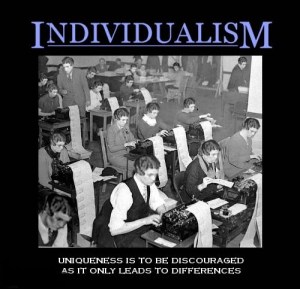
According to Kohl’s, “Americans think they are more individualistic in their thoughts and actions than…They resist being thought of as representatives of a homogeneous group, whatever the group (6).” To this point, I can agree with proof of my own experience. When I first came to Europe, I knew I would be teaching about Culture. I didn’t know that I would be doing so with almost every lesson. I have come to understand and accept this. As my mother has said repeatedly, “Be a good representative.” I know she didn’t just mean in the classroom, never mind that sometimes I wonder if my parents think that I never paid attention to them and their ‘lessons’ growing up, the point is I did. At first, being the collective representative for my country was something I rather ran away from. I came to understand that my students wanted me to tell them, “How it is in America” when I would really give them was, “How it is in my Northwest…or Oregon”.
In fact, I don’t doubt that the students likely had a drinking game connected to how many times I would say in any give week, “In Portland, where I come from…” or “In Oregon, where I come from…” all in an attempt to differentiate between my experience and knowledge of one part of the country to another part that they had just read about or saw a program about on television. I still more or less refuse to give them ‘ultimate’ answers, as I think it only perpetuates stereotypes.
Regarding privacy as a part of individualism, here my father can stand as the epitome. Part of this value is born from Western ideas. During the nineteenth century, western expansion was a full-blown force…the California gold rush, the Oregon trail, the Santa Fe trail, the Homestead Acts and then the west was ‘closed’ because it was settled and full. Ha, what an idea.
My father has retired and now lives in the middle of farm country with 158 acres (63.94 Hectares or 639405.934 meters sq.). For years before he retired and my mother and he moved, all he talked about was how he hated living so close to other people, that he hated the idea of living on top of others (in an apartment) or imagining the view when looking out his window in the morning only to see his neighbors naked body relaxing and drinking coffee (I imagine he didn’t think of it as a young, free-spirited naked woman but rather a free-spirited fat, old, hairy man probably bending over a lot too since he would talk about it with such utter disdain). He was happy to be free of the city (the suburb really) and to be ‘getting back to the land’. The reality today is that, my parents are now getting older and are getting more and more isolated living where they do. My father drives up to the mountain almost daily (about a 2.5 hour drive) and if he isn’t going there, he drives to my sisters place (about 1.5 hours away). My parents love riding bikes but the highway connected to their dirt road is so busy, the locals have nicknamed it ‘Death Highway’ so, do you think they ride very often – no. Plus, my mother worries constantly that when my father is mowing the property, one day the tracker will topple over and she either won’t know right away or won’t be able to get help fast enough to save him. Are you understanding their predicament of individuality?
Furthermore, and this point also goes with point number six, self-help, on a larger scale and in the national media, America prides itself on being led by individuals who have in one way or another, “pulled themselves up by their bootstraps”. Do you know just how hard it is literally to pull oneself up by their own bootstraps? It is a crap saying only true in idealism only. The reality is that America would be nothing without cooperation, collaboration and teamwork. Despite Robert Putnam’s findings in “Bowling Alone” that social capital in America has declined severely since the 1950’s, people need each other more than ever in America, especially since the recession hit in 2007-2008. Proof of this can be found in articles like, “Economy down, volunteering up” by MSNBC which state that from 2009 to 2010 volunteers increased nationwide by 1.6 million with people serving primarily through religious services or community groups.
6. Self-Help/Control.

AmeriCorps, a part of the Corporation for National & Community Service, has helped organize volunteers and serve in communities across the country since 1994. Overall, since 2000, they (specifically the National Civilian Conservation Corps, NCCC) report to have helped by having “served more than 3.4 million hours on over 1,350 disaster service projects… Since Hurricane Katrina struck the Gulf Coast, more than 108,000 participants in the Corporation’s programs – AmeriCorps, Senior Corps, and Learn and Serve America – have contributed over 7.7 million hours in the recovery and rebuilding effort… packed and loaded more than 4,300 pounds of food for distribution to families in St. Bernard Parish, LA…”(AmeriCorps).
I bring this up because we think we can help ourselves, but we do rely so much on other people. Yes, Americans love self-help books and stories about people who have picked themselves up from the bottom. Yet, all to often the story goes far deeper than the individual being presented on the news. Americans are actually finding opportunities to help themselves by helping others. Being pushed to the max by being fired and without work, many Americans have turned to volunteering to learn new skills and make their neighborhoods a better place overall (CNCS).
All too often I think, the individual thinks something must be wrong with them if they cannot find a good job, or meet general American social standards like having a nice car, nice things, a nice place to live and so forth. Take for example this commenter from the Atlantic.com, from August 22, 2011, describing their experience with unemployment in America, “Unemployment dehumanizes (sic) the real person. They lose the essence of their identity and value. To become a number, a label, a resume, a failure, a defect, unproductive, desperate, wishful, delusional, depressed, poor and separated from respectful society. Being unemployed is to be silently disrespected. On a par with being homeless, mentally ill or addicted.” (Thompson) This coming off the heals of news that shareholders are reaping the benefits of their worker’s labor, even as job creation has stalled as well as raises per employee, on average (Eichler). Does this sound like something the individual is doing to themselves?
7. Competition & Free Enterprise.
I have never really considered myself a competitive person. The only sport I ever really played for an extended period of time was softball. Yet there have been times when the fire of competition has sparked in my eyes, if simply to put a rude person humbly in their place. Kohl’s argues that, “Americans feel very strongly that a high competitive economy will bring out the best in its people and ultimately, that the society which fosters competition will progress most rapidly. If you look for it, you will see evidence in all areas – in fields as diverse as medicine, the arts, education, and sports – that free enterprise is the approach most often preferred in America.” To a certain degree this has worked well for us, yet today there are cracks in the facade (see Eichler link above).
As Eliot Spitzer (yes, that Eliot Spitzer) points out, in his opinion, America is actually failing because it isn’t embracing competition (Spitzer). As he see’s it major companies or groups involved with government bailouts that helped tank the American economy continued to play the game as if the game was still set in the nineteenth and twentieth centuries, never mind that it is a new millennium and the game has possibly shifted. This lack of flexibility in these major players, who went on the defense instead of actually questioning and potentially modifying their business practices have thus set the pace for American business and the rest of the economy. Spitzer praises real companies like Apple, who are constantly reinventing themselves to stay ahead of the game and on top of the market (thus remaining a positive force in business). Spitzer sees these two companies as remaining as sticks in the mud and “If we don’t infuse them with a culture of change and love of competition, they will fail once again. The SEC should go out and hire some of the young, recently laid-off traders from hedge funds and investment banks. They need work, and better than any group of lawyers or agent-investigators, they know what trading patterns and practices to examine and where to drop subpoenas to find the skeletons” (Spitzer).
On the smaller scale, because of the economic recession, I think it is harder for everyday Americans to ‘stay ahead of the Jones’s’ in showy-material-wealth and that might not be a bad thing.
8. Future Orientation.
Americans are optimistic. If today sucked, then tomorrow will be that much better and if today was awesome think about what tomorrow will offer – YES!! Things can always improve, through cooperation, self-help or hard work they will always get better! According to Rita Schiano, “True optimists know bad things happen; they experience tragedy just like everyone else. But what separates optimists from their pessimistic brothers and sisters is how they move forward in their thinking and actions relative to those events (Schiano)” and that is Americans in a nutshell (look at me being incredibly general and speaking for my whole country). She also points to a study done by philosopher and futurist Dr. Max More, who points out that optimism is an “empowering, constructive attitude that creates conditions for success by focusing and acting on possibilities and opportunities.”
Kohl’s points out that this also means that Americans devalue the past and in a way ignore the present (which is too bad because it is a gift). This could explain why, in general, America students seem to hate history and do really bad on basic history tests, even about American culture, at least according to a recent study by the Intercollegiate Study Institute entitled, Enlightened Citizenship: Civic Literacy Reports. This is in direct contrast to, what my British friend calls the British way of looking nostalgically to the past. Americans are future-oriented and the Brits are supposedly the exact opposite, thinking their best days are behind them (and possibly wallowing in it?). Which is better to look forward or backward? Why is no one talking about the present, doesn’t that also affect matters?
 livingtheamericandreamineurope.com
One thought on “As American As They Come…”