
How we communicate across cultures says a lot, about ourselves and the culture we keep (and come from).
For example, would you say you are more direct or indirect in the way you speak to others?
Have you heard of the #InterculturalConflict Survey or #ics developed by #mitchellhammer?
It’s purpose is to help us find out how we prefer communicate during conflict so we can learn to be aware of ourselves and better adapt to others.
According to Mitchell R. Hammer, we can chart or comminication style, especially during conflict.
Hammer divided these styles into four quadrants (in yellow) and favored approaches (in light green).
The four main quandrants may be self-explanitory, but not, perhaps, the four favored approaches:
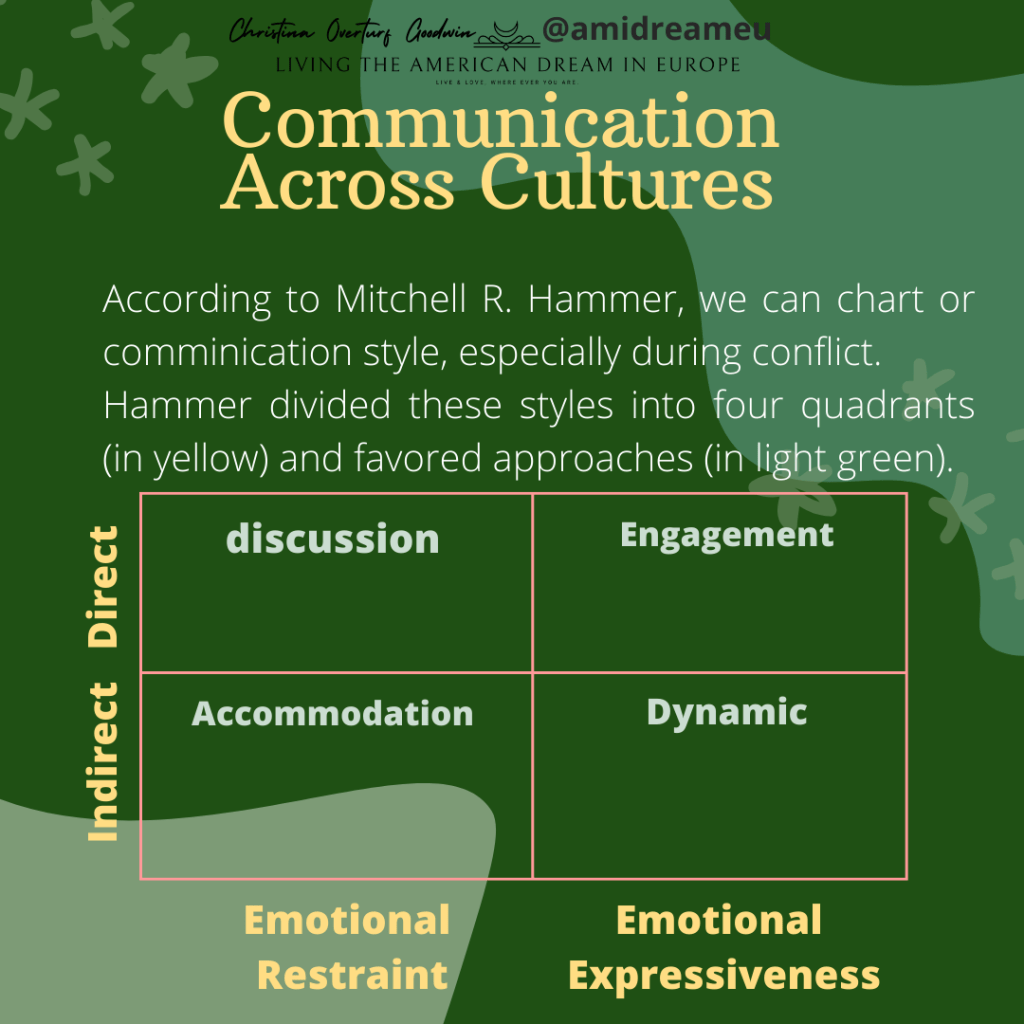
Discussion may be the easiest to describe. You prefer to talk it out without your emotions ‘getting the best of you’, relying on facts rather than feelings. This might be characterized as ‘mean what you say and say what you mean’.
Acommodation means the comunicator likely attempts to indirectly adjust their communication style, minimizing social differences between those speaking, while still remaining relatively emotionally restrained.
These communicators also tend to speak around the issue at hand, in a circular-type manner.
Engagement style is direct while also being emotionally expressive. Issues are discussed with feeling and emotion – here, if it is worth getting worked up over, it is worth discussing. Sincerity is judged by emotional expressiveness. As Hammer put it, “What is nearest the mouth is nearest the heart”
Dynamic style involves both indirect communication, like talking around the issue, with a high degree of emotional expressiveness, often skilled at noticing shifts in non-verbal behavior. As Hammer puts it, “The credibility of each party is grounded in the degree of emotional expressiveness toward the other […].” Often employing stories, metaphors, humor, and use of intermediaries.
Knowing how you communicate in ‘heated’ or conflicting situations means that you can begin to better control and adapt your style to fit the context required.
This is increasingly important as we work with more international clients and coworkers – even without leaving our home countries.
Adaptation does not mean being inauthentic, but truly better able to communicate, under stress, to a variety of individuals in diverse contexts.
A skill for the 21srt century indeed!

But what about you?
It is possible that you are one type of communicator in one setting and another type entirely depending on the context. It could be too that you may fall distinctly between two quadrants & styles.
The best way to find out your style is to take the Intercultural Conflict Style Inventory created by Mitchell R. Hammer at ICSInventory.com
Many Americans tend to be rather direct while the Japanese tend to be more indirect and subtle in their communication style.
This also falls in line with collectivist (Eastern) and individualist (Western) cultures in general.
Additionally, would you say you are more emotionally restraint or emotionally expressive when speaking with others?
It may be important to take into account code switching that happens when we are communicating in different contexts (with family, friends, colleagues, our boss or manager, or strangers). In each case we may practice more or less restraint or expressiveness – whatever we have learned to be ‘normal’ for that setting or group.
Did you know that how you deal with conflict does the same?!
All about Me
When I took the survey I worked hard to think only of how I handle myself in professional situations, not personal ones with family for example.
I landed directly in the middle of #discussion – #accommodation, right on the line!
I should probably take it again with my family discussions in mind to see how differently my placement might be.
Have you ever taken this survey? What did you learn about yourself?
For more information
It is possible that you are one type of communicator in one setting and another type entirely depending on the context. It could be too that you may fall distinctly between two quadrants & styles.
The best way to find out your style is to take the Intercultural Conflict Style Inventory created by Mitchell R. Hammer at ICSInventory.com
 livingtheamericandreamineurope.com