Communication Across Cultures

How we communicate across cultures says a lot, about ourselves and the culture we keep (and come from).

For example, would you say you are more direct or indirect in the way you speak to others?

Have you heard of the #InterculturalConflict Survey or #ics developed by #mitchellhammer?

It’s purpose is to help us find out how we prefer communicate during conflict so we can learn to be aware of ourselves and better adapt to others.

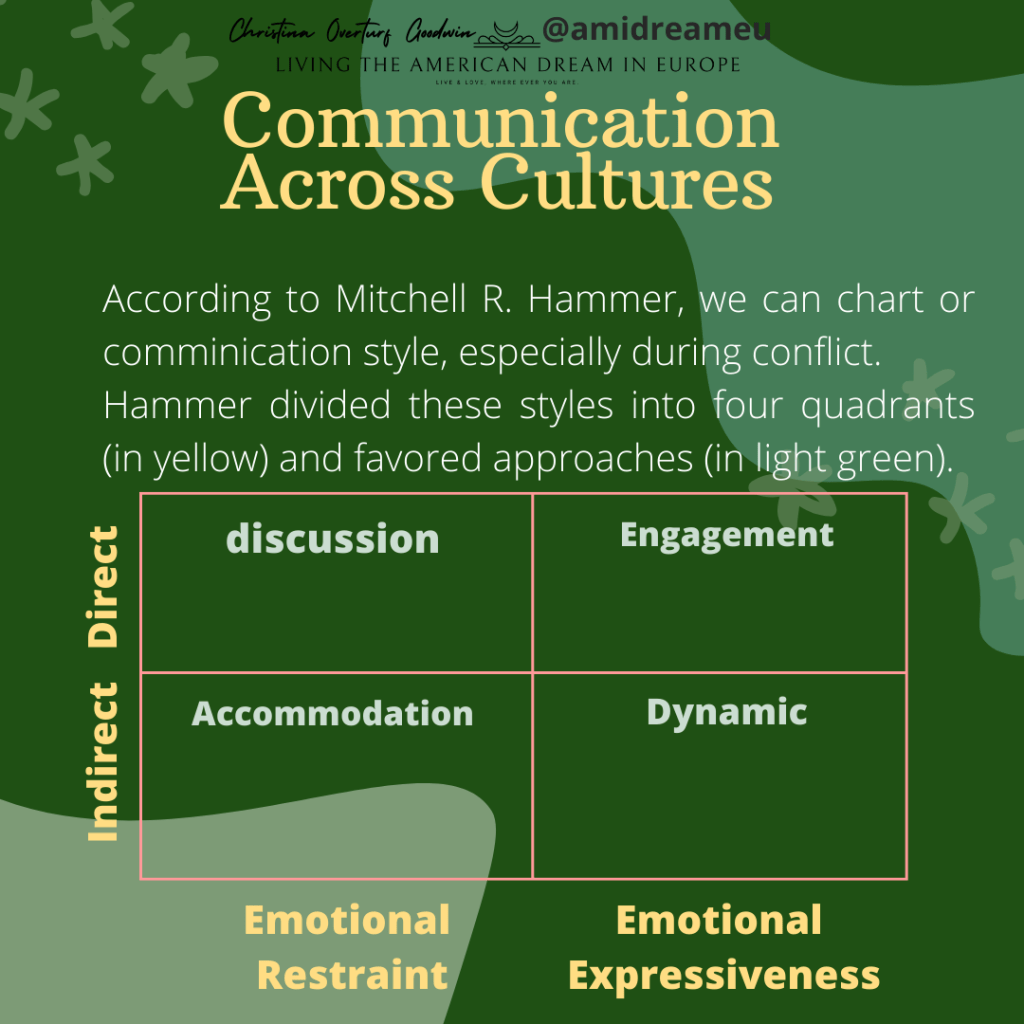
According to Mitchell R. Hammer, we can chart or comminication style, especially during conflict.

Hammer divided these styles into four quadrants (in yellow) and favored approaches (in light green).

The four main quandrants may be self-explanitory, but not, perhaps, the four favored approaches:

Discussion may be the easiest to describe. You prefer to talk it out without your emotions ‘getting the best of you’, relying on facts rather than feelings. This might be characterized as ‘mean what you say and say what you mean’. 

Acommodation means the comunicator likely attempts to indirectly adjust their communication style, minimizing social differences between those speaking, while still remaining relatively emotionally restrained.

These communicators also tend to speak around the issue at hand, in a circular-type manner.

Engagement style is direct while also being emotionally expressive. Issues are discussed with feeling and emotion – here, if it is worth getting worked up over, it is worth discussing. Sincerity is judged by emotional expressiveness. As Hammer put it, “What is nearest the mouth is nearest the heart” 

Dynamic style involves both indirect communication, like talking around the issue, with a high degree of emotional expressiveness, often skilled at noticing shifts in non-verbal behavior. As Hammer puts it, “The credibility of each party is grounded in the degree of emotional expressiveness toward the other […].” Often employing stories, metaphors, humor, and use of intermediaries. 

Knowing how you communicate in ‘heated’ or conflicting situations means that you can begin to better control and adapt your style to fit the context required.

This is increasingly important as we work with more international clients and coworkers – even without leaving our home countries.

Adaptation does not mean being inauthentic, but truly better able to communicate, under stress, to a variety of individuals in diverse contexts.

A skill for the 21srt century indeed!

(image by c.overturfgoodwin, 2025)

But what about you?

It is possible that you are one type of communicator in one setting and another type entirely depending on the context. It could be too that you may fall distinctly between two quadrants & styles.

The best way to find out your style is to take the Intercultural Conflict Style Inventory created by Mitchell R. Hammer at ICSInventory.com

Many Americans tend to be rather direct while  the Japanese tend to be more indirect and subtle in their communication style.

This also falls in line with collectivist (Eastern) and individualist (Western) cultures in general.

Additionally, would you say you are more emotionally restraint or emotionally expressive when speaking with others?

It may be important to take into account code switching that happens when we are  communicating in different contexts (with family, friends, colleagues, our boss or manager, or strangers). In each case we may practice more or less restraint or expressiveness – whatever we have learned to be ‘normal’ for that setting or group.

Did you know that how you deal with conflict does the same?!

All about Me

When I took the survey I worked hard to think only of how I handle myself in professional situations, not personal ones with family for example.

I landed directly in the middle of #discussion – #accommodation, right on the line!

I should probably take it again with my family discussions in mind to see how differently my placement might be.

Have you ever taken this survey? What did you learn about yourself?

For more information

It is possible that you are one type of communicator in one setting and another type entirely depending on the context. It could be too that you may fall distinctly between two quadrants & styles. 

The best way to find out your style is to take the Intercultural Conflict Style Inventory created by Mitchell R. Hammer at ICSInventory.com

What Year End “Wrapped” Says About How We Make Meaning Today

From an intercultural perspective, the spread of year-end “wrapped” formats from Spotify into places like Lidl and LinkedIn is not just a clever marketing trend. It points to several deeper cultural shifts happening at the same time. Here are a few indicators of this shift.

First, wrapped has become a kind of secular ritual. In many societies, shared religious or communal calendars no longer guide reflection. This may feel like a stretch, but hear me out. Platforms now step in to help us mark time. Spotify reflects taste. Lidl reflects consumption. LinkedIn reflects how we perform and narrate our work lives. Each one reassures us that the year meant something and that it had a story rather than just blur. In an uncertain time where individuals are increasingly glued to their devices, this helps restore a feeling of order, even if that order is carefully curated.

Second, data increasingly acts as an identity mirror. These summaries do not show who we say we are. They show who our patterns suggest we are. Our shopping habits, clicks, and professional activity become stand ins for values, priorities, and belonging. If we are our patterns, both seen and unseen, these summaries shed light on the light and the darkness. Culturally, this signals a shift from declared identity to inferred identity.

Third, wrapped compresses complicated complexity into something neatly shareable. Human lives are messy and often contradictory, but wrapped turns that mess into neat, celebratory slides. This is especially appealing in high-pressure, high-uncertainty contexts where people crave coherence. Lidl makes frugality feel intentional. LinkedIn makes fragmented work and often highly curated, jargony language feel like progress. Where earlier generations built connection through informal conversation, shared broadcasts, neighborhood rhythms, or collective belief structures, wrapped now offers a low-effort point of recognition, giving dispersed individuals a fleeting sense of alignment in an otherwise fragmented social landscape.

Fourth, platforms and the stark algorithms behind them are cultivating a sense of intimacy. Through casual, encouraging phrasing, organizations once framed solely around function now position themselves as trusted presences. They appear attentive in ways that everyday encounters often are not, particularly in environments shaped by distraction, acceleration, and cognitive overload. Lidl slips into routines tied to care and bodily maintenance. LinkedIn weaves itself into narratives of capability, status, and aspiration. Spotify maps inner states with uncanny precision. Patterns of listening trace elevation and collapse, momentum and retreat, marking success and disappointment through sound rather than speech. Moods become legible through sequences of tracks, often capturing emotional terrain more accurately than close confidants. What emerges feels familiar and comforting, even as asymmetry and reliance quietly intensify rather than recede.

Fifth, a subtle accommodation of observation has taken hold. Where visibility once required consent or resistance, continuous monitoring is now entered into almost automatically, mediated through devices, networks, and proximity to others. Digital exhaust records movement, behavior, and interaction with little pause or shelter. Wrapped reframes this condition as acknowledgment rather than intrusion. Validation carries emotional reward, and that reward further reduces friction around extraction and analysis. From a cultural standpoint, this signals a shift away from fear toward negotiated tolerance, particularly when the resulting narrative affirms rather than unsettles.

Sixth, the boundaries between consumption, work, and self-branding are collapsing. Spotify was once about taste. LinkedIn about employability. Lidl about everyday economics. When all three use the same reflective format, it suggests that consuming, working, and being are no longer separate spheres. Everything becomes material for identity performance.

Finally, wrapped reflects how late capitalism makes meaning. These stories look backward rather than forward. They celebrate what we already did, not what we might collectively build. Especially when the future is so unpredictable. Will the systems we have come to expect and count on are increasingly chipped away at, it is challenging to maintain a forward-looking foundation of hope. In uncertain times, this backward gaze offers comfort and reassurance, allowing us to warmly look to the ‘good old times’ before.

Lidl and LinkedIn adopting wrapped similar to Spotify is not incidental. It signals how platforms have moved beyond utility into meaning making. They increasingly act as narrators, translating activity into story and offering orientation at a moment when shared reference points feel thin. In a period marked by uncertainty and constant device attachment, it restores a sense of sequence and containment, even when that structure is carefully staged. At the same time, data has become a mirror through which identity is inferred rather than claimed. Patterns speak louder than intentions. What once came from memory, community, or tradition is now algorithmically curated reflection, delivered just in time for the year to close, offering warmth, coherence, and just enough reassurance to carry us forward.

University in the US versus Deutschland

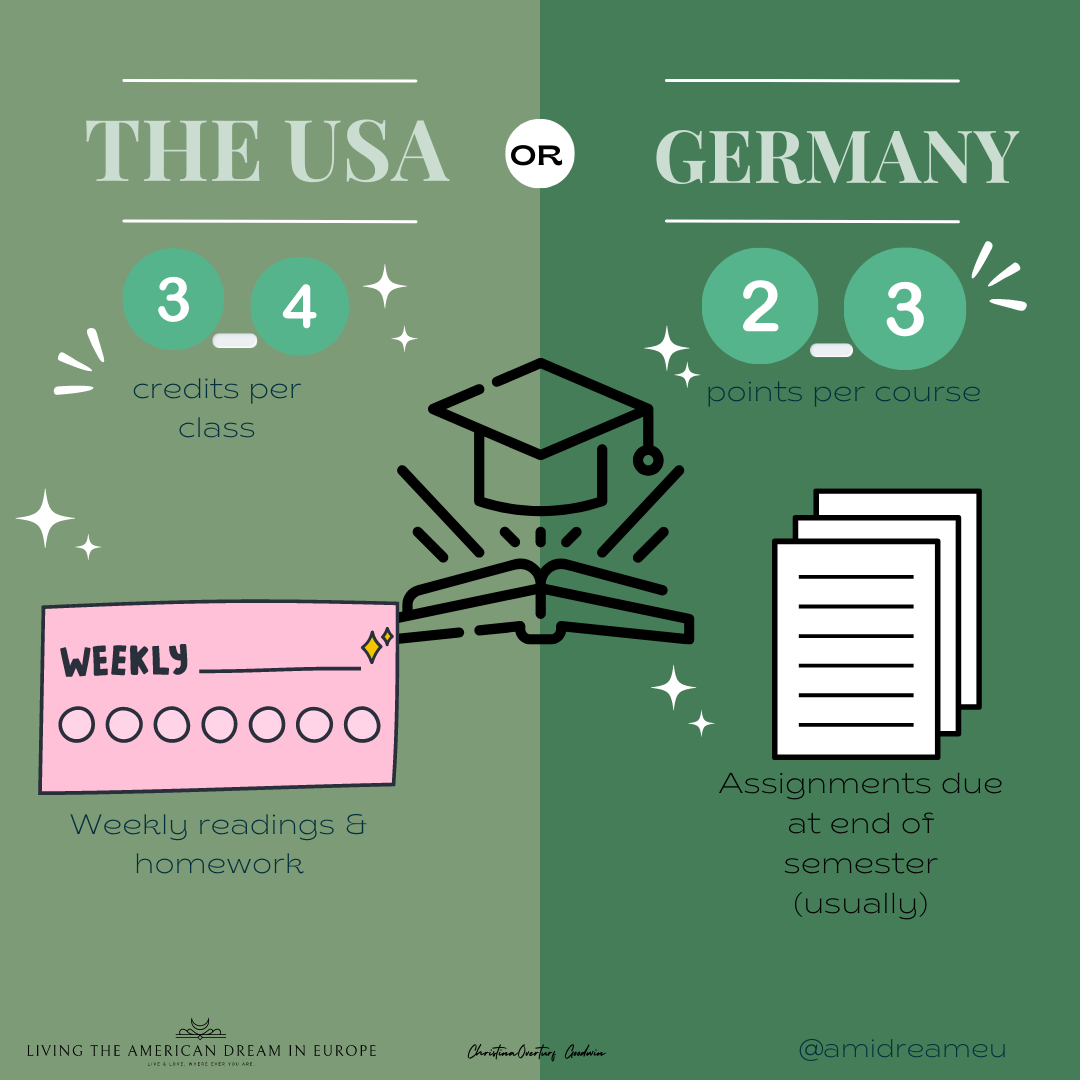
What is university like in Germany versus the USA?

Well, I’ve tried to simplify it as best I can, but of course, it is a bit more nuanced on both sides.

Before I moved to Germany, I met a German exchange student at the graduate level. He didn’t understand why the administration was giving him funny looks for wanting to take ten courses.

In the US, for my part-time graduate degree, I took three courses at least once a week and each course was worth two credits. As an undergraduate university student, full-time could mean taking five or six courses with special permission, but full-time usually consists of four courses, usually worth three or four credit points each, thus equally 12-15 credit points. This meant at least three hours of in-class time for each course, plus weekly homework (readings, writing, reflection, etc.)

As graduate students, we were expected to work during the day and study at night. The workload was demanding and different every week!

The German student was coming from an undergraduate program where it was common for students to take ten or more classes because they’re all worth 2-3 ECTS points (European Credit Transfer System), and course time is between 12-15 weeks depending on if it is summer or winter semester, and homework is usually an exam or course paper due at the end of the semester. One ECTS credit point is worth 25-30 hours in a semester. This is made up of both weekly in-class learning time and independent learning time.

In German universities, students can usually earn 30 ECTS credits per semester and 60 credits in total for an academic year. 

The administration gave that German graduate student in my home university a pass on the course load, but after about 2 weeks he realized he was in over his head and had to drop a few courses.

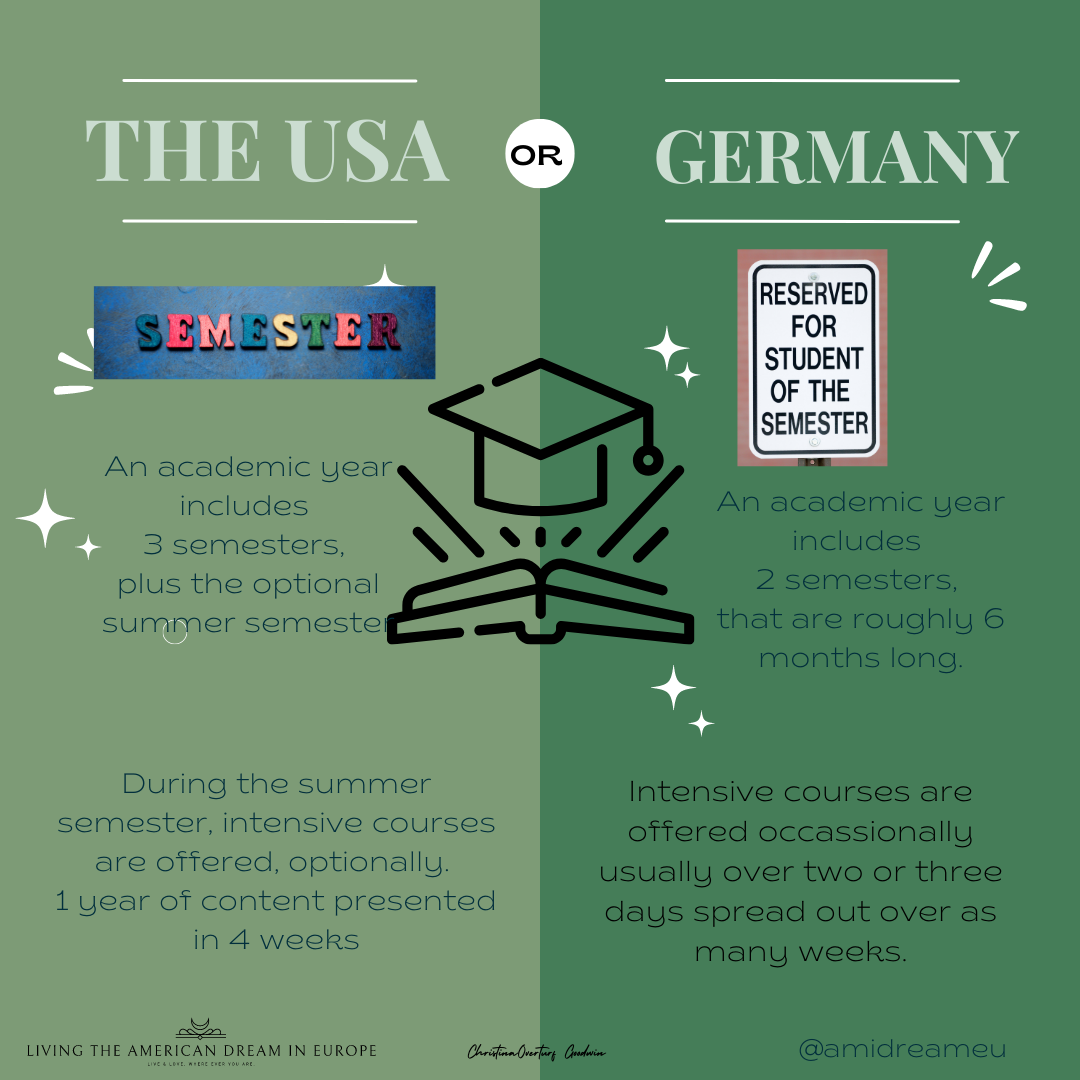
In Germany, students generally have two semesters a year, winter and summer. The winter semester runs from October to March while the summer semester is held from April through September. However, these periods have two distinct periods, course meeting time and then research and writing time. Each of these periods lasts about 15 weeks or three months.

During course meeting time students can take up to 10 courses at a time depending on what they are studying. In many courses (but not all), students are only expected to take notes in lectures and then expected to do their own readings or research and writing only after the course meeting time has finished.

Both systems are demanding but in very different ways. The US system required attendance and participation (weekly homework and class discussions), while the German system required attendance and sometimes participation and homework, with more for the students to do at the end of the semester.

Do you have experience with either of these systems? Tell me about it in the comments.

If you could go back in time, would you?

A question to ponder…

One of the aspects I love about being a language teacher is the flexibility I have in my job.

With some of my clients, the content and delivery is very structured. With others, depending on their available time and interest we watch television programs, films, read books, or current news independently and these discuss when we meet up.

As it is the end of the year, my client today had been reflecting a lot on 2022, as we do. They posited this question, among others.

I loved the conversation it fostered.

My client’s reply was that they would be interested to go back in time to modify an event to see what effect on the present it might have.

As an adult I haven’t said this in a long time…“If I could go back in time…“ because I’ve honestly attempted to live my life appreciating where I’m at and how I got here.

Does that mean that sometimes I put my foot in my mouth or step in it (meaning to say things I wish I hadn’t or to act in ways that later I wish I hadn’t) – Oh buddy, yes.

But that also means that to the best of my ability I’m honest about those errs (mistakes) and attempt to improve my interactions, actions, and reactions in the future.

We can’t change the past but how we approach the present can shape the future. That’s what I like to focus on.

What would you do? If you could go back in time, would you? What would you do? How would you use that time?

How do you approach this time of year – are you reflective, do you make resolutions,…? Tell me in the comments

Juneteenth

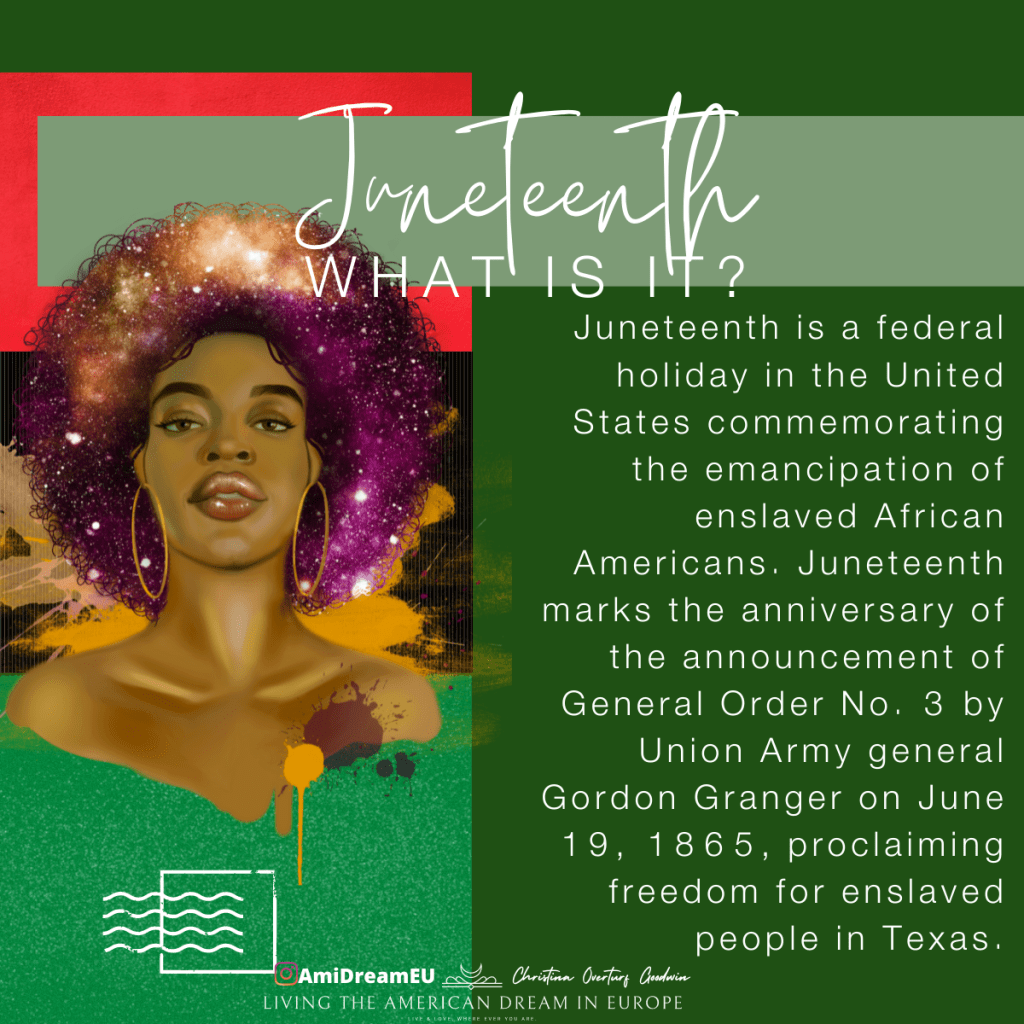
Juneteenth was first celebrated in 1866 on the anniversary of the date that slavery in Texas ended a year earlier in 1865.

It was formally made a paid state holiday in 1980, specifically in Texas. Although it has been observed and celebrated across the US (and some other countries apparently too) since 1866, it wasn’t a formal federal holiday until June 17, 2021.

Why does Juneteenth exist?

June 19, 1865, the day Black people enslaved in Galveston, Texas, learned of their freedom from Union soldiers. The day exists to commemorate the end of slavery in the USA.

How is the day celebrated?

How can you learn more?

WATCH:

  • 13th (Documentary)
  • I Am Not Your Nigra
  • Miss Juneteenth
  • Mudbound
  • Black-ish (TV series)
  • 12 Years a Slave

READ:

  • On Juneteenth by Janet Gordon-Reed
  • Barracoon: The Story of the Last “Black Cargo,” by Zora Neale Hurston
  • Scenes of Subjection, by Saidiya Hartman
  • The Long Emancipation: Moving Toward Black Freedom, by Rinaldo Walcott
  • Juneteenth, by Ralph Ellison

Support Black artists, business owners & entrepreneurs, creators, & designers.

Other Resources

Acheampong, Gemma & Sophie Yarin. “Celebrate Juneteenth with These 15 Films, Podcasts, TV Shows, Albums, and Books” Boston University. Trustees of Boston University. 15.06.2022. https://www.bu.edu/articles/2022/15-films-podcasts-tv-music-books-to-celebrate-juneteenth/

Gates, Henry Louis. “What is Juneteenth?” PBS.org. WNET (2013). https://www.pbs.org/wnet/african-americans-many-rivers-to-cross/history/what-is-juneteenth/

McDonald, Jordan Takisha. “Put Down the Juneteenth Ice Cream and Pick Up These 15 Books A reading list for America’s latest greeting-card category.” Vulture. Vox Media, LLC. 18.06.22. https://www.vulture.com/article/books-about-juneteenth-reading-list.html

Taylor, Derrick Bryson. “Juneteenth: The History of a New Holiday.” The New York Times. The Bew York Times, LLC. 08.06.22. https://www.google.com/amp/s/www.nytimes.com/article/juneteenth-day-celebration.amp.html

Image text adapted from Wikipedia & Britannica.

What is culture? (part II)

In intercultural communication (IC) training, culture is one of the first things discussed. Doing so helps participants set into the mindset of thinking about culture, something that we don’t generally do on any given day, especially not without being prompted to.

I didn’t necessarily think I had a ‘real’ culture coming from America many years ago because I didn’t understand American culture beyond the Founding Fathers, its major cultural epochs, politics, & popular culture which is increasingly rebooted films & reality TV.

I was deep in the ‘fishbowl’ then, not realizing I was surrounded by all the cultural ‘water’ that I was immersed in.

I am in a very different place now, both figuratively & literally.

Today, I am immersed in culture all of the time because I have studied it casually since 2008. In 2021 specifically, I studied it professionally to earn my intercultural communication training certification. I have realized that culture impacts just about everything we do.

You have likely heard of the ‘chicken and the egg’ dilemma, as in which came first? Well, within each one of us is a similar question related to culture. What about us is related to culture and what about us is just our personality?

So, whether you know a thing about culture or not, here is some basic information to help you check in with yourself in the hope that maybe you can be one step closer to answering your chicken and egg dilemma question…

How would you define culture?

Here are a few of the ‘standard’ models used to discuss what culture is with a brief explanation of each model. Most IC trainers have a favorite model or two that they prefer or will use often, but this is generally a way to only begin the discussion.

Choose an example and attempt to identify how your culture is the tree, the onion, or whichever you choose. What are the similarities between the object you have chosen and ‘culture’? How might this understanding help you better work across cultures?

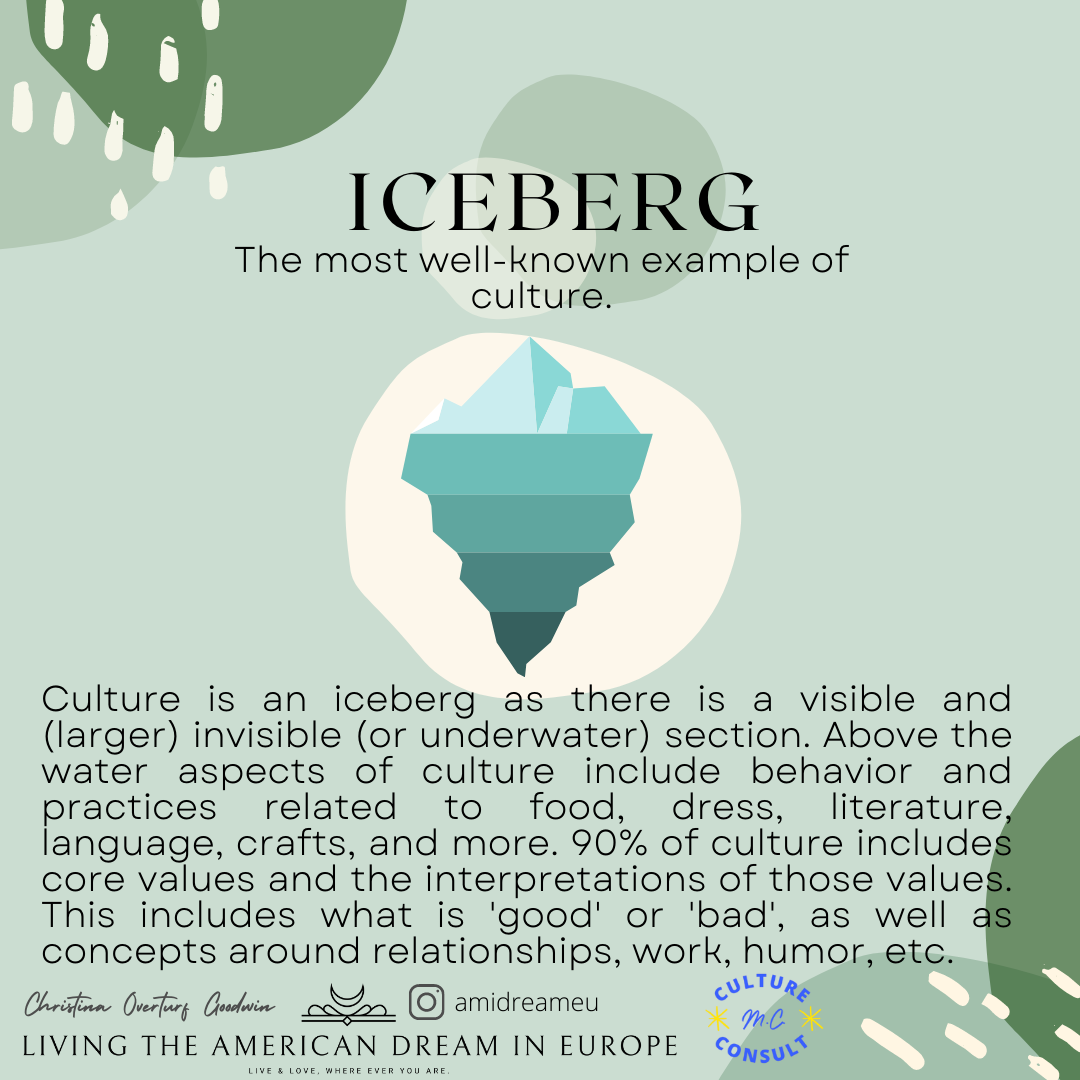
The iceberg is perhaps the most common visual representation of culture. When we think of culture we only think about what we can observe with our senses. These are often clearly identifiable things like gender, religion, family, foods, music, clothing, nationality, famous buildings, literature, icons, or art and architecture. Additionally, because of this, we tend to only think of others in simple terms, one-dimensionally. This is whilst at the same time thinking of ourselves and those we know like us as multidimensional beings.

Deeper under the surface of the iceberg are the aspects of culture that we cannot identify with our senses, these aspects are also usually more difficult to adapt or shift. On the other hand, the items noted previously that are above the surface are much easier to adapt to. Much more challenging is changing how we think about certain things, especially when our worldview is strikingly different than our own.

The tree is perhaps my favorite example of culture. Its roots represent the origin and a sense of belonging to various groups. The trunk is the values important to your personal cultural context. Finally, the leaves are the visible culture, including communication and conflict styles.

The sand dune is similar to the tree in how is it used to examine culture, however, it is a bit more abstract for many. Here the topmost layer is related to individuals and smaller communities that can be negotiated. The middle layer or sediment is the facts of the culture. The deeper in the dune we dig, the more compacted and set the culture becomes.

It may be helpful to see these three levels like this: The top level is the ‘can’ level, the middle is the ‘should’ level, and the bottom is ‘have to’. In the specific cultural groups, what ‘can’ members do or possibly get away with, within context, and still remain in the group. What guidelines, behaviors, or traditions ‘should’ members follow to remain and be accepted in the group? Finally, what norms, laws, or prohibitions do members ‘have to’ follow their membership?

The problem here might be that we may have never given much thought to these points so articulating them, even to ourselves, might be a challenge.

An onion is perhaps second to the iceberg in its potential ease in understanding its relationship to culture, even if it isn’t necessarily liked as food (especially raw). People can usually identify with the layered sense of self to those layers of an onion. Often though problems occur when we forget to give this understanding to others, easily believing that others are not as multifaceted as we are. This is our human error, especially when we are under stress.

The last example, but by no means the be-all-end-all of the examples, is eyewear or eyeglasses. The goal of working through these ideas is to understand that there are many interpretations when looking at the same thing and others’ interpretations are not wrong, just different.

“A people without the knowledge of their past history, origin, and culture is like a tree without roots.”

Marcus Garvey

Over to you

Are there any other visuals that come to mind? Which ones and why?

Which is your preferred metaphor for culture? Did you have one before coming across this post? Why or why not?

Please let me know in the comments.

Today

Today, my heart is heavy.

When I was a child, I always thought life would be easier and better when I was older. Then, a little older I thought life would be better living abroad.

Neither of these is really true. They are stories I told myself to get through whatever I was going through at the moment. I’ve learned life is richer because of how varied and diverse it is – not because I am or am not in a specific place or time.

Life is good for me, my family, and a lot of other people right now. It could always be better, which is what I think most people strive for, but it could also be a lot worse.

I am thankful daily for what I have, am able to do, and the way I am able to live and work.

I cannot even think about any of this being taken away from me. I literally cannot fathom it. Yet, that is what so many people in Ukraine woke up to just a few days ago.

People have died, lost their homes, their livelihoods. People are having to take up civilian arms, making Molotov cocktails to have at the ready when Russian troops fully enter Kyiv and the ground war begins. Others are attempting to find shelter in the subway or in basements if they cannot flee.

Why?!
For a power-hungry egoist seemingly seeking previous glory from a bygone era? Maybe Putin thinks life would be better, richer, more right by taking Ukraine – but this is not reality.

What is to stop this from happening again elsewhere. As an Ami living in Europe, I don’t have the luxury of saying the conflict is ‘over there’. It feels so close, physically, emotionally, mentally.

We think borders define us, they don’t – not wholly. We think our politics or politicians define us, they don’t. There is proof of this in the hundreds of Russians protesting their government. If you or I are truly multifaceted, so are ‘they’…as is every person on this planet.


These Ukrainians are my friends, neighbors, fellows in this life who were just going to work, having meals with their families and friends, hugging their children. Who’s to say they are not us. They are.

They deserve better than this.

Is this the oldest company in Germany?

I first came across this idea when I was looking for things to do in Rheinland-Pfalz that my family has not yet done. Then, suddenly I was seeing references to this place a lot. Now I know the internet plays a part in this – it ‘magically’ multiplies what you search for, showing you more of it. This is likely a factor but doesn’t explain my husband’s sudden desire to watch travel shows about the Mosel River or Rheinland-Pfalz.

In Germany, (arguably) the oldest company still in operation is a winery first formed in 862 as part of a wine-producing Abby in the town of Kröv, near Traben-Trabach and Bernkastel Kues. Here, I am speaking of the Staffelter Hof in a little wine village along the Mosel River between Bernkastel-Kues and Traben-Trabach.

via BusinessFinancing.co.uk (06.02.2020)

I say arguably because other resources on the internet claim others are the oldest. However, outside of Wikipedia, the best resources I could find on the internet claimed the ‘oldest business in Germany’ was a brewery, Weihenstephan Monastery Brewery (Bayerische Staatsbrauerei Weihenstephan, Freising) that began in 1030. Of course, it would be a brewery. The next oldest company according to the same article said the next business, also a brewery, began in 1040.

Another website claims the oldest winery in Germany is Niersteiner Glöck. According to Germanwines.com “A historic charter proves that the vineyard “Niersteiner Glöck” is Germany’s oldest named vineyard site. It was gifted in 742 by the Diocese of Würzburg to the Carolingian ruler Majordomo Karlmann, uncle of Charlemagne.” (source) The next notable oldest winery in Germany is Schloss Johannisberg between Bingen and Mainz. This winery was apparently the first to be solely planted with Riesling grapes – meaning the first in the world, then became the first vineyard to produce the ‘Spätlese’ a German term for late harvest wine that is produced from fully ripe grapes—in 1775. However, the vineyard was first apparently planted in 817. “The vineyards around the palace were first mentioned in 817 when Emperor Ludwig the Pious (also known as Louis the Pious) acquired them from Fulda Abbey.” (source)

What exactly makes Staffelterhof different from these other wineries?

First records of Staffelterhof can be found in Liege Belgium’s city archives since, at the time, the area was controlled by the Carolingian Dynasty (relating to Charlemagne).

This was the case until 1804 when the Napoleonic Code replaced feudal law with clearly written laws across Europe.

In 1805 the winery was bought by the Peter Schneiders family who has subsequently passed it down through the family over seven generations to its current winemaker, Jan Klein, who took over from his father, Gerd Klein.

In the 1960s the family added a guest house to the property, which has been run by Jan Klein’s mother ‘Gundi’.

Staffelterhof Guest House, 2022

Not shown is the (peach) schnapps we also bought, which is produced and distilled on the property (along with other flavors too) since 1890.

Additionally not visible is the wonderfully casual nature of the exchange that took place. We rolled up, not knowing where to park – so parked near the entrance. Knocked on their door, which I think was also the entrance to their house. Asked if we could buy some wine and were treated to a small wine tasting. I would have gladly had more, but I was driving.

🍷Prost!

Over to you

What is the oldest company in your country?

Have you ever visited Germany’s Mosel or Rhein wine region? What are your favorite wineries, experiences, or memories from your visit?

Have you tried any of the wines from the wineries mentioned here? What did you think of them?

Other Resources:

  • “German Firms with the Longest Corporate History”. (12.07.2019) Catherine Delikhan (hg) – DW.com
  • “List of the Oldest Still Operating German Companies”. (14.08.2007) Thomas Jannot – just4business.com
  • “Oldest Wineries in the World.” (10.04.21) Manas Sen Gupta – Prestigeonline.com
  • Staffelterhof homepage
  • Staffelterhof – Wikipedia (English) (German)
  • “The Oldest Companies in the World”. (06.02.2020) – Businessfinancing.co.uk. (with beautiful infographics)
  • “The World’s Oldest Companies Still Operating Today”. (25.04.2017) Amber Pariona – WorldAtlas.com

Groundhog Day

I know I am publishing this well past February 2nd, but still think it is culturally relevant, especially in 2022…

During the pandemic, at least in the English-speaking western world “Groundhog Day” the popular 1993 film became a shorthand joke for how we’re all supposed to get out of this Corona wave loop.

Do you know what this day means in North American culture?!

Well, look at the following watch a short video or the images that follow to learn more about this day in North America.

Video created by ME.

Here is the 1993 trailer for the American cult classic film.

Do you know how the film ended? Do you know how Bill Murray’s character stopped having to live like every day was ‘Groundhog Day’?

I have read some pretty great analyses of what this film really means or stands for. My favorites are in this Mentalfloss article by Jennifer M Wood from 2019. As I love exploring self-help, the idea that the film is a ‘self-help bible’ is somewhat interesting. Is there more to this 90s film than pure entertainment?

When it was released, the point of the film was that its main character was a self-involved jerk, which serves no one, not even the person who is ultimately self-involved. So, Murray’s character becomes stuck on February 2 reliving the day ad nauseam until he learns there is more to life than he himself and his interests or whims. He has to evolve or continue being stuck.

Do you see how this became an allegory for the Corona pandemic?

Also, if you like this type of film American Actor Andy Samberg starred in a modern retelling of this situation, albeit sans February 2nd, in 2020s “Palm Springs”.

Over to you

Have you seen either one of these films? What do you think is the message behind the original film? Is there a greater meaning beyond that which we can see from a face-value viewing of Groundhog Day or Palm Springs? Do you think the two films’ modern connection to the Corona Pandemic is appropriate or warranted, why or why not?


Gaudi or Gaudy

Gaudy is an adjective that means ‘extravagantly bright or showy, so as to be tasteless’.

Synonyms include ‘garish’, ‘elaborate’, ‘lurid’, ‘glaring’, harsh’, ‘ornate’, and ‘flashy’. 

Photo by Gvantsa Gongadze on Pexels.com

Gaudi, as in the Catalan architect Antoni Gaudi, who is credited with such world-renowned works as Park Güell, Casa Battló (one of my favorite), and La Sagrada Familia in Barcelona (the most visited monument in Spain) who lived from 1852 to 1926, specializing in the Modernisme or Catalan-specific Arte Nouveau style incorporating natural with architectural elements and religious symbolism (at times). Seven of his works in Spain have been deemed World Heritage sites by UNESCO. 

Photo by Ovidio Rey on Pexels.com

Yes, clearly I am a fan of the latter.

My question to you is, is the latter the origin of the former and, what does this have to do with culture? 

Get new content delivered directly to your inbox.

While the two are similar, Gaudi’s work is definitely ornate, leaning toward ‘ornate’ or ‘intricate’ if you are not a fan.

The word actually comes from the 16th century, specifically, the 1580’s when it meant ‘joyfully festive’, which itself is likely a re-using of an early 14th-century noun meaning ‘large, ornate bead in a rosary’. Alternatively, this adjective could come from Middle English or Old French ‘gaudegrene’ from the early 14th century, which was the name of a yellowish-green pigment, transforming from ‘well-dyed’ to ‘bright ornamentation’. 

The long and the short of it is that the word is older than the man. 

Popular culture is awash in the idea that the word is named after the man. After visiting the Sagrada Familia for the first time I bought a biography of Gaudi that purported this idea as well. 

Photo by Charl Durand on Pexels.com

In his time, Modernisme or Arte Nouveau was, in part, a return to the past in response to the industrial revolution and thus stiff forms perpetrating art and design at the time. Politically and ideologically, it was seen as a way for the bourgeoisie (the middle, or capitalist class with its perceived materialistic or conventional values.) to identify with more of their Catalan cultural roots.

It could be that people have been divided by Gaudi’s work from the beginning.
As the BBC’S John Glancy put it in 2014, “George Orwell said it was “one of the most hideous buildings in the world” and rather hoped it would be destroyed during the Spanish Civil War. Salvador Dalí spoke of its “terrifying and edible beauty”, saying it should be kept under a glass dome. Walter Gropius, master of right-angled architecture and founder of the Bauhaus, praised its technical perfection. Louis Sullivan, the great American architect, and “father of skyscrapers”, described it as a “spirit symbolized in stone.”

Photo by Enrico Perini on Pexels.com

Over to You

What do you think, tell me in the comments: 
Were you aware of the origin of the word Gaudy?
Did you also think the origin of the word Gaudy and the man Gaudi were related?
Have you ever been to see or walk among any of Gaudi’s works in Spain? If so, where did you go and what did you think?