When “Rude” Is Cultural: Rethinking Social Norms Across Cultures

After reflecting recently on the concept of respect, I began thinking about other slippery words we often use to describe behavior. Words that seem straightforward until we place them into a cultural context.

In a previous reflection I mentioned a few examples including trust, communication, and collaboration.

Another word that deserves attention is rude.

Photo by Luiz Fernando on Pexels.com

What Does “Rude” Actually Mean?

Many definitions describe rudeness as behavior that violates social norms in ways that are impolite, disrespectful, or discourteous. This might include interrupting others while they speak, speaking loudly in quiet environments, cutting in line, or using vulgar language in situations where it is considered inappropriate.

A key distinction is intent. Rudeness often occurs without the deliberate intention to cause harm. That separates it from meanness or cruelty, where someone intentionally tries to hurt another person.

Yet even this definition becomes complicated when culture enters the picture.

Common Sense Is Cultural

What counts as rude depends heavily on the social norms of a particular community.

Poverty researcher, writer, and speaker Donna Beegle captures this idea succinctly when she says that we do not know what we do not know.

What we call “common sense” is usually the product of cultural learning. Families, schools, workplaces, and communities teach us certain expectations about how people should behave.

Those expectations can feel universal until we encounter a different cultural system.

Photo by Yan Krukau on Pexels.com

Learning Cultural Rules the Hard Way

When I first moved to Germany, I frequently encountered moments where I unknowingly violated expectations within bureaucratic systems.

During those interactions I occasionally heard the phrase:

“You should know this.”

As a foreigner navigating unfamiliar administrative rules, my reaction was often to ask a practical question.

“How would I know this? Who is supposed to teach me? Is it you? Your manager? Someone else? If there is a class I should take, I will happily take it.”

More often than not the response included a deep sigh and some variation of the statement:

“It is not my job. But I do not know whose job it is.”

Those moments revealed something important.

The invisible rules of culture affect everyone involved. Even the people enforcing them may not know where those rules were originally learned.

The Limits of Interpreting Motivation

Another challenge arises when we assume we understand why someone behaved the way they did.

In reality, we cannot speak to a stranger’s motivations unless we have the courage to ask them.

Back in the United States, if I felt brave enough, I might ask someone directly whether they were okay. Many people carry struggles that remain invisible until someone gently asks.

Sometimes a simple question can reveal that the person who seemed rude is actually overwhelmed, stressed, or having a difficult day.

In my adopted home in Germany, I do not always feel the same level of cultural comfort asking strangers that kind of question. Cultural norms around privacy and boundaries can make those conversations feel less natural.
Photo by Brett Jordan on Pexels.com

A Small Pause Before Judgment

Instead, I have developed a small practice for moments when someone’s behavior initially feels rude.

First I pause and notice what that feeling actually feels like in my body.

Then I think of the acronym HALT.

🤤 Hungry
😡 Angry or 🥺 Anxious
😢 Lonely
😩 Tired

These states influence how we interpret social interactions. If I am experiencing one of them, I may be more likely to perceive someone’s actions negatively.

Then I ask myself a few questions.

  • Did I misunderstand something?
  • Did I unknowingly break a local social rule?
  • Could the other person also be experiencing HALT?

Often I assume that HALT is influencing one or both of us, and that there may also be a cultural misunderstanding layered into the interaction.

Photo by Danik Prihodko on Pexels.com

The Role of Trusted Perspectives

One of the most valuable tools for navigating these moments has been having a small circle of trusted friends who understand both cultures.

Talking through confusing interactions with them often reveals possibilities I had not considered. Sometimes the situation turns out to be a cultural misunderstanding. Sometimes it is simply a human one.

Either way, those conversations help transform frustration into learning.

Curiosity Instead of Certainty

Intercultural competence does not eliminate misunderstandings. They remain part of interacting across cultures.

What changes is our response to them.

Instead of immediately labeling someone as rude, we begin to ask different questions.

What expectations shaped this moment?
What social rule might I be missing?
What might the other person be experiencing?

Often the answer is surprisingly simple.

Neither person intended to be rude.

They were simply operating within different versions of what they believed was common sense.
The Many Meanings of “Respect”

Lately, I’ve found myself reflecting (yet again) on the idea of respect.

As a white female from the global North living outside of her home country, I ponder this word a lot.

At first glance, it feels like such a strong and straightforward word. It is something most of us aspire to give and hope to receive in return.

But the more I think about it, the more complicated it becomes.

The Oxford Dictionary lists 25 definitions of the word. Two of the most common are:

  1. A feeling of admiration for someone because of their qualities or achievements.
  2. Polite behavior toward someone or something you consider important.

Both sound clear enough.

Yet in everyday life, people often use the word to mean something quite different.

Sometimes respect means: “I respect you because you hold authority over me.”

And sometimes the inverse: “I do not respect you because you, as a person, are beneath me in status, finances, or position.”

Suddenly the word starts to feel less simple.

Photo by Saji Hakami on Pexels.com

Respect Across Cultures

When you add cultural context, the picture becomes even more complex.

In some environments, respect means being direct and honest. But not too direct. Otherwise you risk being perceived as harsh or even cruel.

In other contexts, respect is demonstrated through hierarchy and status. Knowing your place in relation to others becomes an important signal of respect.

In still other cultures, respect shows up through restraint in communication. The respectful person is the one who reads the room, notices body language, and understands what is being communicated without words.

Each of these approaches can feel completely natural to the people who practice them. Yet they can easily be misunderstood by others.

The Blurry Edges of Respect

Respect also becomes ambiguous in everyday interactions.

Consider a few examples.

Respect might mean being fully transparent. Sharing the real reason you had to go to the doctor last month, or openly discussing why a project or company is struggling in a room filled with both close colleagues and people you barely know.

But in another setting, that same level of openness could be considered inappropriate or unprofessional.

Respect might mean alerting someone to a problem without offering solutions, because suggesting actions could be seen as overstepping.

In a different environment, respect might require the opposite: clearly naming the problem and proposing concrete next steps.

Respect might mean giving someone honest feedback.

Or it might mean protecting the relationship by choosing silence.

In some places, respect means speaking up.

In others, respect means not challenging someone publicly.

None of these interpretations are necessarily wrong.

They are simply different.

Photo by Cup of Couple on Pexels.com

The Challenge of a Shared Word

And this is where things get interesting.

All of these people, each carrying their own understanding of what “respect” looks like, are walking around interacting with one another every day.

  • At work.
  • In families.
  • In friendships.
  • Across cultures.

So when someone says, “Please be respectful,” I’m not trying to be contrarian when I ask a question.

I’m genuinely curious.

  • Respectful to whom?
  • Respectful for what purpose?
  • Respectful in this particular context?

Part of that curiosity comes from feeling comfortable asking. But it also comes from wanting to better understand the room I’m in.

Words That Sound Simple But Aren’t

“Respect” is one of those words that feels obvious until you start examining it.

Two others that often strike me as similarly slippery are trust and communication.

We use them constantly.

But ask ten people what they mean by them, and you will likely hear ten different answers.

Words like these can seem universal on the surface. Yet once we look more closely, they reveal a surprising amount of complexity.

A Question for You

What are your thoughts on respect?

Are there other words that seem simple but turn out to be surprisingly complicated once you start unpacking them?

I would be curious to hear which “sticky words” show up most often in your own work, relationships, or cross cultural experiences.

Trust, Control, and Creativity: Can the SEMCO Style Work in Today’s Workplace?

What actually makes people happier and more creative at work?

This question sat at the center of a Young SIETAR webinar I participated in exploring the SEMCO Style, a management philosophy popularized by Brazilian business leader Ricardo Semler.

Rather than simply presenting the model, participants examined it through several influential intercultural frameworks developed by Fons Trompenaars, Geert Hofstede, and Richard D. Lewis, which I greatly appreciated. Grounding a ‘business leadership idea’ in cultural frameworks works for me because I do not originally come from the business world, thus the basics were a little easier to relate to after this.

These models helped us ask a deeper question in the webinar. Not only what do these leadership principles mean, but how realistic are they across cultures and modern workplaces?

I had never heard of the SEMCO Style before, so all of this was new to me.

The SEMCO approach rests on five core principles. Each builds on the others.

1. Trust as the Foundation

Trust sits at the base of the entire framework. Without it, none of the other principles can function.

Yet trust is not universal in how it develops. In some cultural contexts it is built slowly through repeated interaction and demonstrated reliability. In others, trust is initially extended and only withdrawn if agreements are violated.

During the discussion, some pointed out that trust operates beyond the interpersonal level. It can also exist at a societal scale. Citizens trust institutions to govern in ways that protect both present and future generations. For me, having a history in political theory, this idea echoes the social contract theory described by Jean Jacques Rousseau.

Trust, in other words, is both personal and structural.

A man actively balances on a woman in a yoga-like acrobatic pose.
Photo by Sergey Romanenko on Pexels.com

2. Reducing Control

If trust grows, control can decrease.

The modern workplace offers strong examples in both directions. Since the pandemic, some organizations have increased oversight through monitoring tools, strict return to office policies, and tighter productivity metrics. Companies such as Amazon, Goldman Sachs, and Tesla have publicly discussed stricter workplace expectations in recent years.

At the same time, other organizations have experimented with reduced control and increased autonomy. Remote-first companies such as GitLab and flexible workplace models like those used at Spotify highlight a different path.

Reducing control does not necessarily mean removing structure. Instead, it often means designing systems that allow people with different levels of experience to work effectively.

A newcomer may need more guidance and regular feedback. A seasoned professional may thrive with far greater independence.

3. Self Management

When trust increases and rigid control decreases, self management becomes possible.

Traditional corporate structures (and general business models) tend to be hierarchical and top down. Decisions move downward and responsibility moves upward.

The SEMCO philosophy flips that assumption. Individuals and teams are encouraged to take ownership of their work, manage priorities, and contribute ideas more directly.

For early career professionals, this might involve learning how to organize tasks, communicate progress, and manage accountability. For experienced practitioners, it can open space for experimentation, initiative, and creative problem solving.

When implemented well, self management shifts motivation away from compliance and toward intrinsic engagement.

Photo by Thirdman on Pexels.com

4. Extreme Stakeholder Alignment

The fourth principle is often the most controversial.

SEMCO suggests aligning the interests of employees, organizations, and other stakeholders so that professional goals and personal motivations are not in conflict.

Historically, work and personal life were treated as clearly separate spheres. Professional identity existed in one space and personal purpose in another.

The idea of stakeholder alignment challenges that division by suggesting that individuals can pursue meaningful work that also advances organizational goals.

Yet many professionals question whether such alignment is realistic in an era where corporate profits have expanded rapidly while worker autonomy, security, and compensation have not always kept pace.

The concept is compelling, but its implementation raises important questions. I especially felt strong pushback as the host was describing this principal. I honestly have rarely heard of this succeeding beyond small and medium-sized businesses. Am I mistaken?

5. Creative Innovation

The final principle is the outcome of the previous four.

When trust exists, control is balanced, individuals manage their work, and goals are aligned, organizations may create environments where innovation emerges more naturally.

One practical method discussed during the webinar was Agile coaching, a leadership approach supported by the Agile Alliance.

Agile principles emphasize several key ideas:

  • Individuals and interactions over rigid processes
  • Working solutions over excessive documentation
  • Customer collaboration over contract negotiation
  • Responding to change rather than following fixed plans

In practice, this often means smaller teams working in short cycles, meeting regularly to review progress, adjust priorities, and respond to real user needs. Technology companies such as Spotify and Atlassian have publicly documented how Agile structures help teams adapt more quickly to customer feedback and evolving markets.

The Bigger Question

The SEMCO philosophy offers an appealing vision of work built on trust, autonomy, and shared purpose.

Yet, the conversation during the webinar returned repeatedly to one central question.

Can this model truly function across modern global workplaces, or does it succeed mainly in specific sectors such as technology, startups, or creative industries?

Intercultural perspectives complicate the answer even further. Expectations around hierarchy, authority, and individual autonomy vary significantly across cultures.

What feels empowering in one context may feel uncertain or uncomfortable in another.

Exploring these tensions is exactly why conversations like this matter. Leadership models rarely exist outside cultural context.

And the future of work will likely depend on how thoughtfully we navigate those differences.

What are your thoughts on this? I am truly curious as you, reader, likely have more experience here than me.

Communication Across Cultures

How we communicate across cultures says a lot, about ourselves and the culture we keep (and come from).

For example, would you say you are more direct or indirect in the way you speak to others?

Have you heard of the #InterculturalConflict Survey or #ics developed by #mitchellhammer?

It’s purpose is to help us find out how we prefer communicate during conflict so we can learn to be aware of ourselves and better adapt to others.

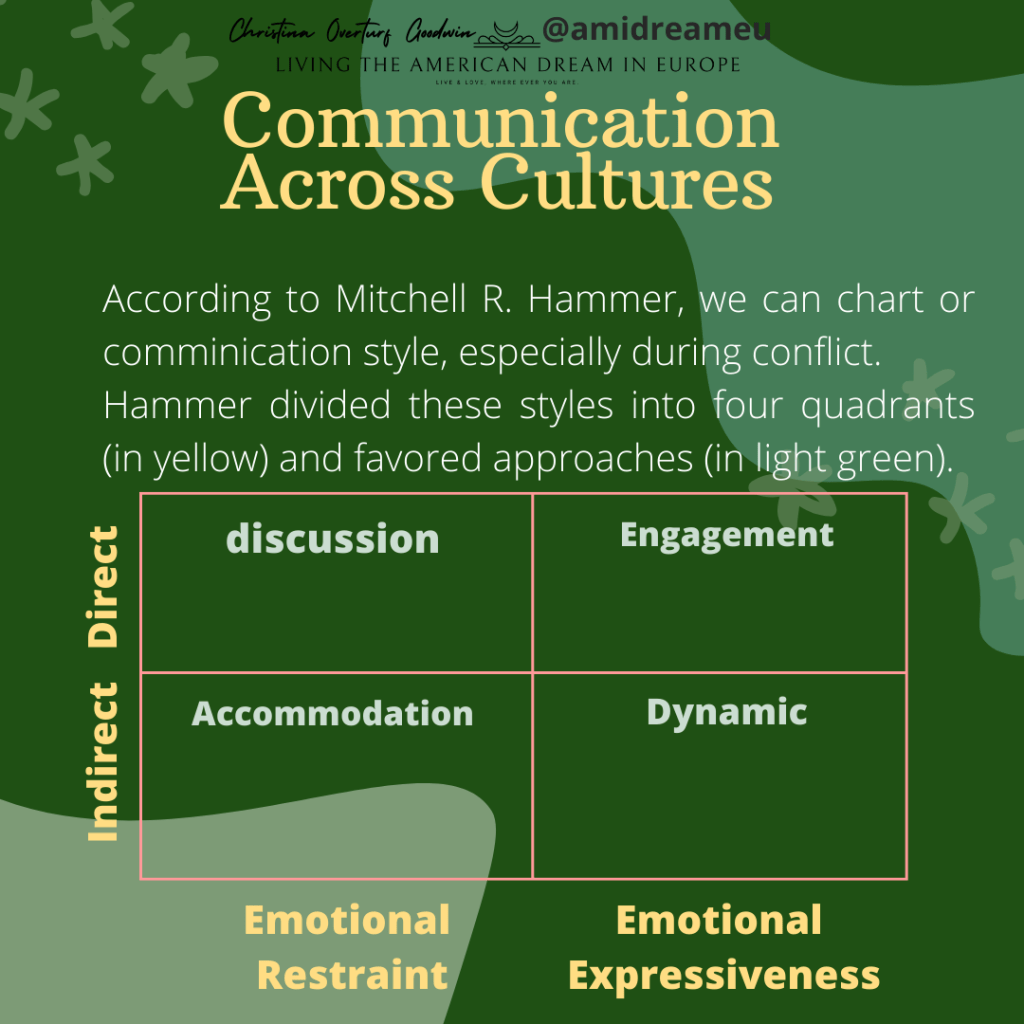
According to Mitchell R. Hammer, we can chart or comminication style, especially during conflict.

Hammer divided these styles into four quadrants (in yellow) and favored approaches (in light green).

The four main quandrants may be self-explanitory, but not, perhaps, the four favored approaches:

Discussion may be the easiest to describe. You prefer to talk it out without your emotions ‘getting the best of you’, relying on facts rather than feelings. This might be characterized as ‘mean what you say and say what you mean’. 

Acommodation means the comunicator likely attempts to indirectly adjust their communication style, minimizing social differences between those speaking, while still remaining relatively emotionally restrained.

These communicators also tend to speak around the issue at hand, in a circular-type manner.

Engagement style is direct while also being emotionally expressive. Issues are discussed with feeling and emotion – here, if it is worth getting worked up over, it is worth discussing. Sincerity is judged by emotional expressiveness. As Hammer put it, “What is nearest the mouth is nearest the heart” 

Dynamic style involves both indirect communication, like talking around the issue, with a high degree of emotional expressiveness, often skilled at noticing shifts in non-verbal behavior. As Hammer puts it, “The credibility of each party is grounded in the degree of emotional expressiveness toward the other […].” Often employing stories, metaphors, humor, and use of intermediaries. 

Knowing how you communicate in ‘heated’ or conflicting situations means that you can begin to better control and adapt your style to fit the context required.

This is increasingly important as we work with more international clients and coworkers – even without leaving our home countries.

Adaptation does not mean being inauthentic, but truly better able to communicate, under stress, to a variety of individuals in diverse contexts.

A skill for the 21srt century indeed!

(image by c.overturfgoodwin, 2025)

But what about you?

It is possible that you are one type of communicator in one setting and another type entirely depending on the context. It could be too that you may fall distinctly between two quadrants & styles.

The best way to find out your style is to take the Intercultural Conflict Style Inventory created by Mitchell R. Hammer at ICSInventory.com

Many Americans tend to be rather direct while  the Japanese tend to be more indirect and subtle in their communication style.

This also falls in line with collectivist (Eastern) and individualist (Western) cultures in general.

Additionally, would you say you are more emotionally restraint or emotionally expressive when speaking with others?

It may be important to take into account code switching that happens when we are  communicating in different contexts (with family, friends, colleagues, our boss or manager, or strangers). In each case we may practice more or less restraint or expressiveness – whatever we have learned to be ‘normal’ for that setting or group.

Did you know that how you deal with conflict does the same?!

All about Me

When I took the survey I worked hard to think only of how I handle myself in professional situations, not personal ones with family for example.

I landed directly in the middle of #discussion – #accommodation, right on the line!

I should probably take it again with my family discussions in mind to see how differently my placement might be.

Have you ever taken this survey? What did you learn about yourself?

For more information

It is possible that you are one type of communicator in one setting and another type entirely depending on the context. It could be too that you may fall distinctly between two quadrants & styles. 

The best way to find out your style is to take the Intercultural Conflict Style Inventory created by Mitchell R. Hammer at ICSInventory.com

What Year End “Wrapped” Says About How We Make Meaning Today

From an intercultural perspective, the spread of year-end “wrapped” formats from Spotify into places like Lidl and LinkedIn is not just a clever marketing trend. It points to several deeper cultural shifts happening at the same time. Here are a few indicators of this shift.

First, wrapped has become a kind of secular ritual. In many societies, shared religious or communal calendars no longer guide reflection. This may feel like a stretch, but hear me out. Platforms now step in to help us mark time. Spotify reflects taste. Lidl reflects consumption. LinkedIn reflects how we perform and narrate our work lives. Each one reassures us that the year meant something and that it had a story rather than just blur. In an uncertain time where individuals are increasingly glued to their devices, this helps restore a feeling of order, even if that order is carefully curated.

Second, data increasingly acts as an identity mirror. These summaries do not show who we say we are. They show who our patterns suggest we are. Our shopping habits, clicks, and professional activity become stand ins for values, priorities, and belonging. If we are our patterns, both seen and unseen, these summaries shed light on the light and the darkness. Culturally, this signals a shift from declared identity to inferred identity.

Third, wrapped compresses complicated complexity into something neatly shareable. Human lives are messy and often contradictory, but wrapped turns that mess into neat, celebratory slides. This is especially appealing in high-pressure, high-uncertainty contexts where people crave coherence. Lidl makes frugality feel intentional. LinkedIn makes fragmented work and often highly curated, jargony language feel like progress. Where earlier generations built connection through informal conversation, shared broadcasts, neighborhood rhythms, or collective belief structures, wrapped now offers a low-effort point of recognition, giving dispersed individuals a fleeting sense of alignment in an otherwise fragmented social landscape.

Fourth, platforms and the stark algorithms behind them are cultivating a sense of intimacy. Through casual, encouraging phrasing, organizations once framed solely around function now position themselves as trusted presences. They appear attentive in ways that everyday encounters often are not, particularly in environments shaped by distraction, acceleration, and cognitive overload. Lidl slips into routines tied to care and bodily maintenance. LinkedIn weaves itself into narratives of capability, status, and aspiration. Spotify maps inner states with uncanny precision. Patterns of listening trace elevation and collapse, momentum and retreat, marking success and disappointment through sound rather than speech. Moods become legible through sequences of tracks, often capturing emotional terrain more accurately than close confidants. What emerges feels familiar and comforting, even as asymmetry and reliance quietly intensify rather than recede.

Fifth, a subtle accommodation of observation has taken hold. Where visibility once required consent or resistance, continuous monitoring is now entered into almost automatically, mediated through devices, networks, and proximity to others. Digital exhaust records movement, behavior, and interaction with little pause or shelter. Wrapped reframes this condition as acknowledgment rather than intrusion. Validation carries emotional reward, and that reward further reduces friction around extraction and analysis. From a cultural standpoint, this signals a shift away from fear toward negotiated tolerance, particularly when the resulting narrative affirms rather than unsettles.

Sixth, the boundaries between consumption, work, and self-branding are collapsing. Spotify was once about taste. LinkedIn about employability. Lidl about everyday economics. When all three use the same reflective format, it suggests that consuming, working, and being are no longer separate spheres. Everything becomes material for identity performance.

Finally, wrapped reflects how late capitalism makes meaning. These stories look backward rather than forward. They celebrate what we already did, not what we might collectively build. Especially when the future is so unpredictable. Will the systems we have come to expect and count on are increasingly chipped away at, it is challenging to maintain a forward-looking foundation of hope. In uncertain times, this backward gaze offers comfort and reassurance, allowing us to warmly look to the ‘good old times’ before.

Lidl and LinkedIn adopting wrapped similar to Spotify is not incidental. It signals how platforms have moved beyond utility into meaning making. They increasingly act as narrators, translating activity into story and offering orientation at a moment when shared reference points feel thin. In a period marked by uncertainty and constant device attachment, it restores a sense of sequence and containment, even when that structure is carefully staged. At the same time, data has become a mirror through which identity is inferred rather than claimed. Patterns speak louder than intentions. What once came from memory, community, or tradition is now algorithmically curated reflection, delivered just in time for the year to close, offering warmth, coherence, and just enough reassurance to carry us forward.

University in the US versus Deutschland

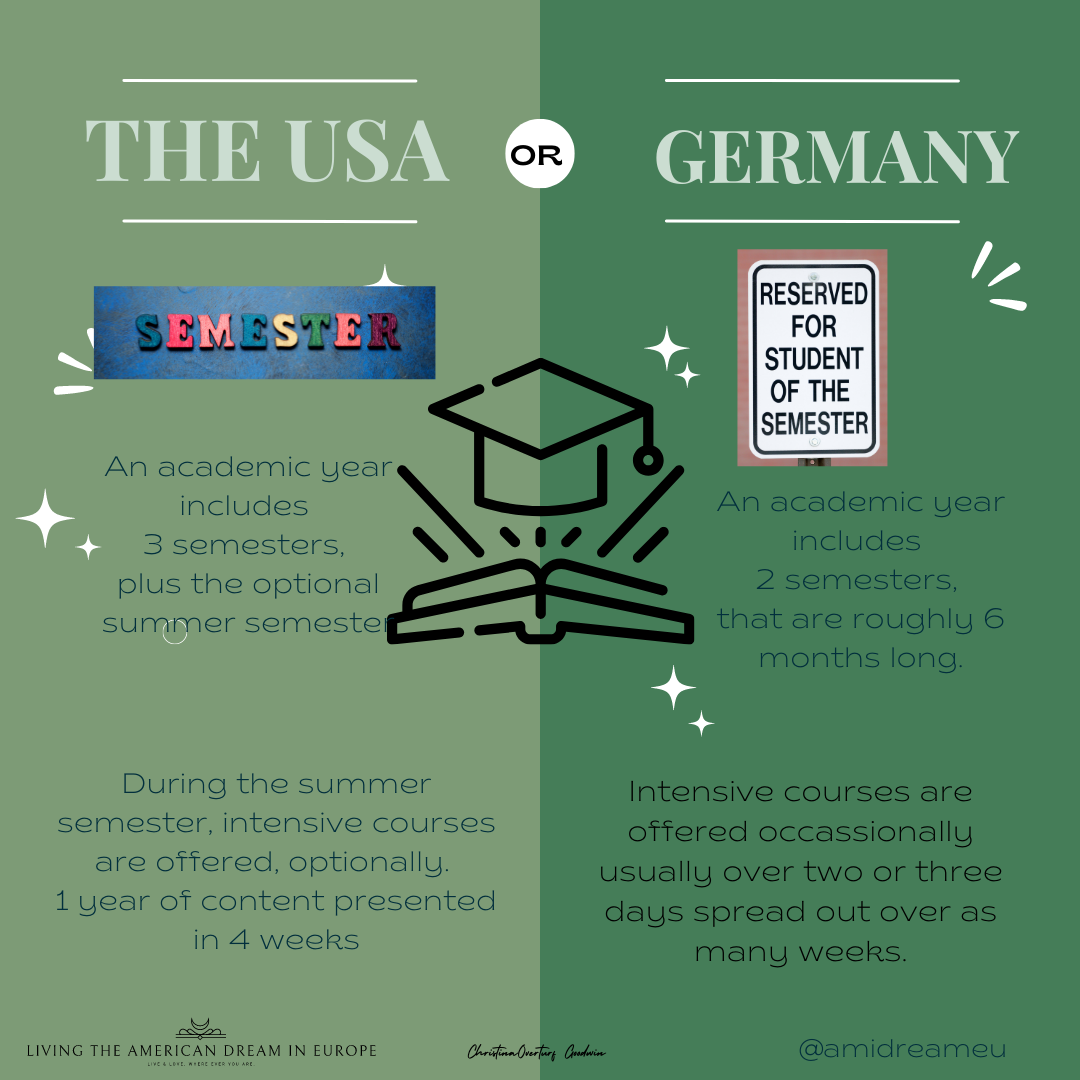
What is university like in Germany versus the USA?

Well, I’ve tried to simplify it as best I can, but of course, it is a bit more nuanced on both sides.

Before I moved to Germany, I met a German exchange student at the graduate level. He didn’t understand why the administration was giving him funny looks for wanting to take ten courses.

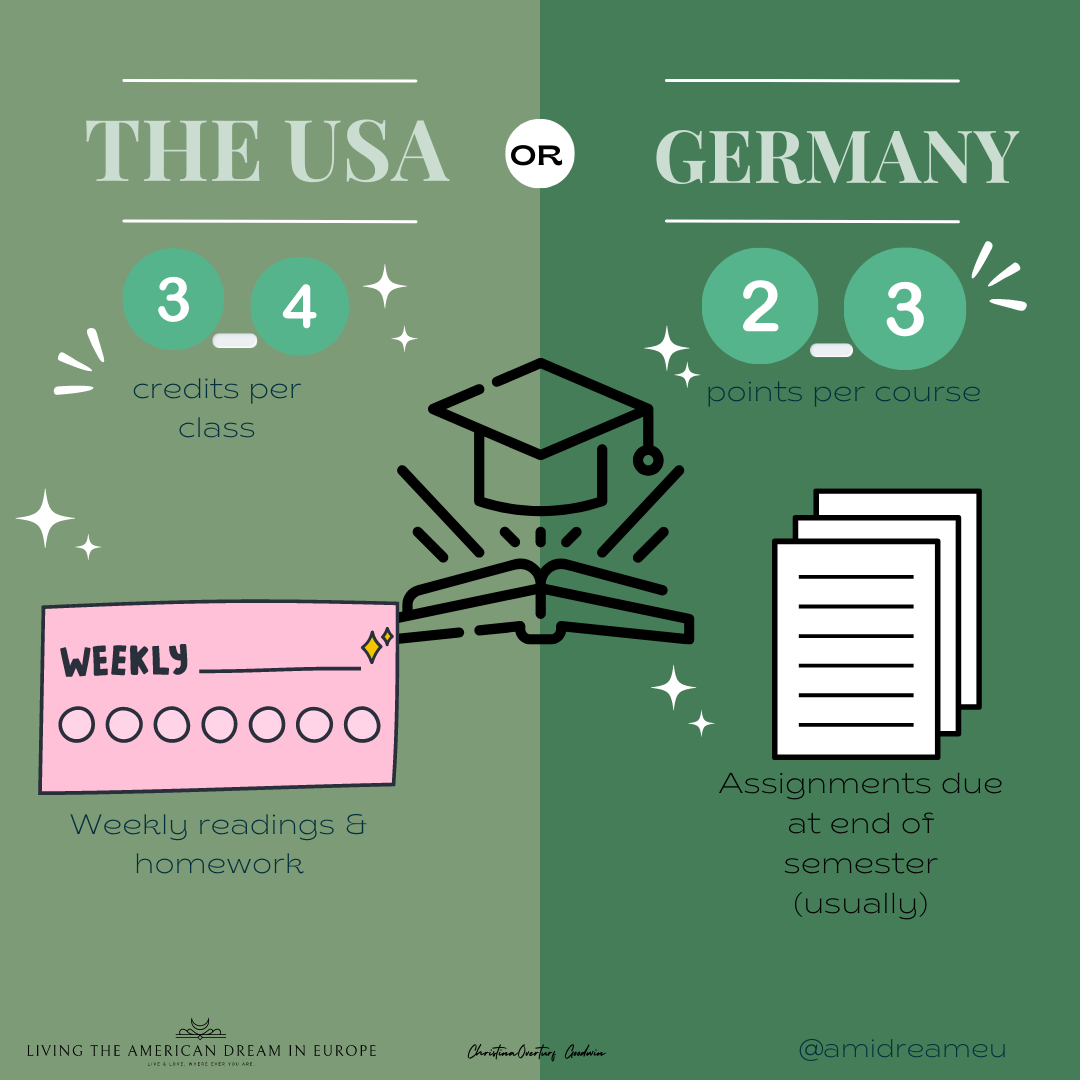
In the US, for my part-time graduate degree, I took three courses at least once a week and each course was worth two credits. As an undergraduate university student, full-time could mean taking five or six courses with special permission, but full-time usually consists of four courses, usually worth three or four credit points each, thus equally 12-15 credit points. This meant at least three hours of in-class time for each course, plus weekly homework (readings, writing, reflection, etc.)

As graduate students, we were expected to work during the day and study at night. The workload was demanding and different every week!

The German student was coming from an undergraduate program where it was common for students to take ten or more classes because they’re all worth 2-3 ECTS points (European Credit Transfer System), and course time is between 12-15 weeks depending on if it is summer or winter semester, and homework is usually an exam or course paper due at the end of the semester. One ECTS credit point is worth 25-30 hours in a semester. This is made up of both weekly in-class learning time and independent learning time.

In German universities, students can usually earn 30 ECTS credits per semester and 60 credits in total for an academic year. 

The administration gave that German graduate student in my home university a pass on the course load, but after about 2 weeks he realized he was in over his head and had to drop a few courses.

In Germany, students generally have two semesters a year, winter and summer. The winter semester runs from October to March while the summer semester is held from April through September. However, these periods have two distinct periods, course meeting time and then research and writing time. Each of these periods lasts about 15 weeks or three months.

During course meeting time students can take up to 10 courses at a time depending on what they are studying. In many courses (but not all), students are only expected to take notes in lectures and then expected to do their own readings or research and writing only after the course meeting time has finished.

Both systems are demanding but in very different ways. The US system required attendance and participation (weekly homework and class discussions), while the German system required attendance and sometimes participation and homework, with more for the students to do at the end of the semester.

Do you have experience with either of these systems? Tell me about it in the comments.

If you could go back in time, would you?

A question to ponder…

One of the aspects I love about being a language teacher is the flexibility I have in my job.

With some of my clients, the content and delivery is very structured. With others, depending on their available time and interest we watch television programs, films, read books, or current news independently and these discuss when we meet up.

As it is the end of the year, my client today had been reflecting a lot on 2022, as we do. They posited this question, among others.

I loved the conversation it fostered.

My client’s reply was that they would be interested to go back in time to modify an event to see what effect on the present it might have.

As an adult I haven’t said this in a long time…“If I could go back in time…“ because I’ve honestly attempted to live my life appreciating where I’m at and how I got here.

Does that mean that sometimes I put my foot in my mouth or step in it (meaning to say things I wish I hadn’t or to act in ways that later I wish I hadn’t) – Oh buddy, yes.

But that also means that to the best of my ability I’m honest about those errs (mistakes) and attempt to improve my interactions, actions, and reactions in the future.

We can’t change the past but how we approach the present can shape the future. That’s what I like to focus on.

What would you do? If you could go back in time, would you? What would you do? How would you use that time?

How do you approach this time of year – are you reflective, do you make resolutions,…? Tell me in the comments

Juneteenth

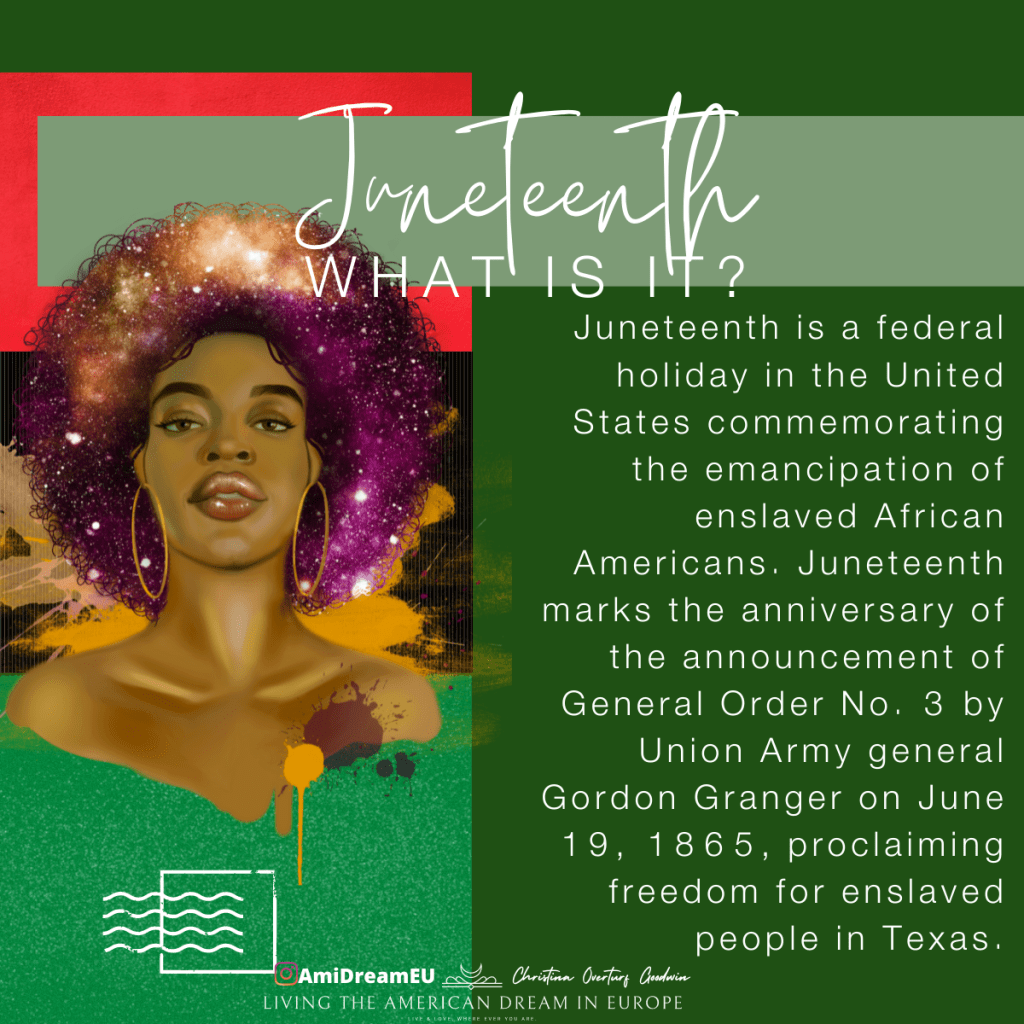
Juneteenth was first celebrated in 1866 on the anniversary of the date that slavery in Texas ended a year earlier in 1865.

It was formally made a paid state holiday in 1980, specifically in Texas. Although it has been observed and celebrated across the US (and some other countries apparently too) since 1866, it wasn’t a formal federal holiday until June 17, 2021.

Why does Juneteenth exist?

June 19, 1865, the day Black people enslaved in Galveston, Texas, learned of their freedom from Union soldiers. The day exists to commemorate the end of slavery in the USA.

How is the day celebrated?

How can you learn more?

WATCH:

  • 13th (Documentary)
  • I Am Not Your Nigra
  • Miss Juneteenth
  • Mudbound
  • Black-ish (TV series)
  • 12 Years a Slave

READ:

  • On Juneteenth by Janet Gordon-Reed
  • Barracoon: The Story of the Last “Black Cargo,” by Zora Neale Hurston
  • Scenes of Subjection, by Saidiya Hartman
  • The Long Emancipation: Moving Toward Black Freedom, by Rinaldo Walcott
  • Juneteenth, by Ralph Ellison

Support Black artists, business owners & entrepreneurs, creators, & designers.

Other Resources

Acheampong, Gemma & Sophie Yarin. “Celebrate Juneteenth with These 15 Films, Podcasts, TV Shows, Albums, and Books” Boston University. Trustees of Boston University. 15.06.2022. https://www.bu.edu/articles/2022/15-films-podcasts-tv-music-books-to-celebrate-juneteenth/

Gates, Henry Louis. “What is Juneteenth?” PBS.org. WNET (2013). https://www.pbs.org/wnet/african-americans-many-rivers-to-cross/history/what-is-juneteenth/

McDonald, Jordan Takisha. “Put Down the Juneteenth Ice Cream and Pick Up These 15 Books A reading list for America’s latest greeting-card category.” Vulture. Vox Media, LLC. 18.06.22. https://www.vulture.com/article/books-about-juneteenth-reading-list.html

Taylor, Derrick Bryson. “Juneteenth: The History of a New Holiday.” The New York Times. The Bew York Times, LLC. 08.06.22. https://www.google.com/amp/s/www.nytimes.com/article/juneteenth-day-celebration.amp.html

Image text adapted from Wikipedia & Britannica.

What is culture? (part II)

In intercultural communication (IC) training, culture is one of the first things discussed. Doing so helps participants set into the mindset of thinking about culture, something that we don’t generally do on any given day, especially not without being prompted to.

I didn’t necessarily think I had a ‘real’ culture coming from America many years ago because I didn’t understand American culture beyond the Founding Fathers, its major cultural epochs, politics, & popular culture which is increasingly rebooted films & reality TV.

I was deep in the ‘fishbowl’ then, not realizing I was surrounded by all the cultural ‘water’ that I was immersed in.

I am in a very different place now, both figuratively & literally.

Today, I am immersed in culture all of the time because I have studied it casually since 2008. In 2021 specifically, I studied it professionally to earn my intercultural communication training certification. I have realized that culture impacts just about everything we do.

You have likely heard of the ‘chicken and the egg’ dilemma, as in which came first? Well, within each one of us is a similar question related to culture. What about us is related to culture and what about us is just our personality?

So, whether you know a thing about culture or not, here is some basic information to help you check in with yourself in the hope that maybe you can be one step closer to answering your chicken and egg dilemma question…

How would you define culture?

Here are a few of the ‘standard’ models used to discuss what culture is with a brief explanation of each model. Most IC trainers have a favorite model or two that they prefer or will use often, but this is generally a way to only begin the discussion.

Choose an example and attempt to identify how your culture is the tree, the onion, or whichever you choose. What are the similarities between the object you have chosen and ‘culture’? How might this understanding help you better work across cultures?

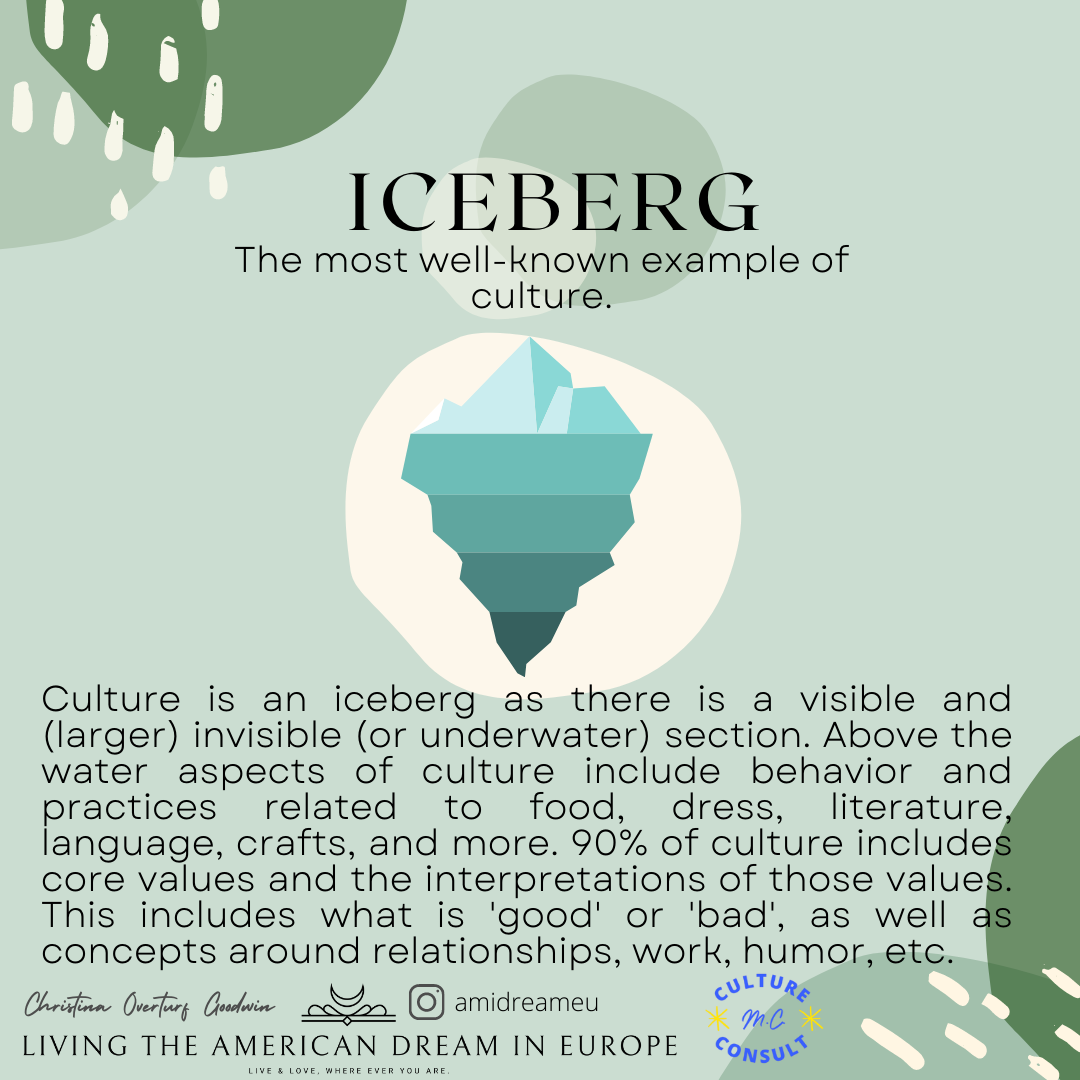
The iceberg is perhaps the most common visual representation of culture. When we think of culture we only think about what we can observe with our senses. These are often clearly identifiable things like gender, religion, family, foods, music, clothing, nationality, famous buildings, literature, icons, or art and architecture. Additionally, because of this, we tend to only think of others in simple terms, one-dimensionally. This is whilst at the same time thinking of ourselves and those we know like us as multidimensional beings.

Deeper under the surface of the iceberg are the aspects of culture that we cannot identify with our senses, these aspects are also usually more difficult to adapt or shift. On the other hand, the items noted previously that are above the surface are much easier to adapt to. Much more challenging is changing how we think about certain things, especially when our worldview is strikingly different than our own.

The tree is perhaps my favorite example of culture. Its roots represent the origin and a sense of belonging to various groups. The trunk is the values important to your personal cultural context. Finally, the leaves are the visible culture, including communication and conflict styles.

The sand dune is similar to the tree in how is it used to examine culture, however, it is a bit more abstract for many. Here the topmost layer is related to individuals and smaller communities that can be negotiated. The middle layer or sediment is the facts of the culture. The deeper in the dune we dig, the more compacted and set the culture becomes.

It may be helpful to see these three levels like this: The top level is the ‘can’ level, the middle is the ‘should’ level, and the bottom is ‘have to’. In the specific cultural groups, what ‘can’ members do or possibly get away with, within context, and still remain in the group. What guidelines, behaviors, or traditions ‘should’ members follow to remain and be accepted in the group? Finally, what norms, laws, or prohibitions do members ‘have to’ follow their membership?

The problem here might be that we may have never given much thought to these points so articulating them, even to ourselves, might be a challenge.

An onion is perhaps second to the iceberg in its potential ease in understanding its relationship to culture, even if it isn’t necessarily liked as food (especially raw). People can usually identify with the layered sense of self to those layers of an onion. Often though problems occur when we forget to give this understanding to others, easily believing that others are not as multifaceted as we are. This is our human error, especially when we are under stress.

The last example, but by no means the be-all-end-all of the examples, is eyewear or eyeglasses. The goal of working through these ideas is to understand that there are many interpretations when looking at the same thing and others’ interpretations are not wrong, just different.

“A people without the knowledge of their past history, origin, and culture is like a tree without roots.”

Marcus Garvey

Over to you

Are there any other visuals that come to mind? Which ones and why?

Which is your preferred metaphor for culture? Did you have one before coming across this post? Why or why not?

Please let me know in the comments.

Today

Today, my heart is heavy.

When I was a child, I always thought life would be easier and better when I was older. Then, a little older I thought life would be better living abroad.

Neither of these is really true. They are stories I told myself to get through whatever I was going through at the moment. I’ve learned life is richer because of how varied and diverse it is – not because I am or am not in a specific place or time.

Life is good for me, my family, and a lot of other people right now. It could always be better, which is what I think most people strive for, but it could also be a lot worse.

I am thankful daily for what I have, am able to do, and the way I am able to live and work.

I cannot even think about any of this being taken away from me. I literally cannot fathom it. Yet, that is what so many people in Ukraine woke up to just a few days ago.

People have died, lost their homes, their livelihoods. People are having to take up civilian arms, making Molotov cocktails to have at the ready when Russian troops fully enter Kyiv and the ground war begins. Others are attempting to find shelter in the subway or in basements if they cannot flee.

Why?!
For a power-hungry egoist seemingly seeking previous glory from a bygone era? Maybe Putin thinks life would be better, richer, more right by taking Ukraine – but this is not reality.

What is to stop this from happening again elsewhere. As an Ami living in Europe, I don’t have the luxury of saying the conflict is ‘over there’. It feels so close, physically, emotionally, mentally.

We think borders define us, they don’t – not wholly. We think our politics or politicians define us, they don’t. There is proof of this in the hundreds of Russians protesting their government. If you or I are truly multifaceted, so are ‘they’…as is every person on this planet.


These Ukrainians are my friends, neighbors, fellows in this life who were just going to work, having meals with their families and friends, hugging their children. Who’s to say they are not us. They are.

They deserve better than this.