High Culture versus Low Culture

Culture is defined in the dictionary as:
1) the beliefs, customs, arts, etc., of a particular society, group, place, or time,
2) a particular society that has its own beliefs, ways of life, art, etc., and
3) a way of thinking, behaving or working that exists in a place or organization (such as a business). 

Photo by Beatriz Jara on Pexels.com

High culture is aspects of culture that are deemed ‘superior’ and usually associated with (and consumed by) the elite in society: the well-educated or wealthy. It usually requires special education or training to develop and understand and is accepted by authoritative institutions as having ‘great value, importance, or significance. (Read: of greater value)

Whereas, low culture is seen as the opposite, meaning generally mass appeal popular culture. This mass appeal can be seen as rather basic, innocent, and escapist. Low culture often employs tropes and stereotypes that can be seen as offensive, emotional, and unbalanced (read: of less value).

Both terms ‘high’ and ‘low’ culture are seen as derogatory, or disrespectful toward the other. Popular culture, which changes more rapidly and, within this context is seen as a ‘lesser’ aspect of culture as it relates to socioeconomic status. 

Photo by Fam Vontini on Pexels.com

Examples of high culture include (but are not limited to) classical music, ballet, the fine arts, poetry, and some literature. Whereas examples of low culture include kitsch, slapstick, camp, escapist fiction, popular music, comic books, tattoo art, and exploitation films. A modern example of low culture could be reality tv programs and, opposite to this, examples of modern high culture include high-end fashion (think the Berkin bag or Louis Vuitton), food, or fads. 

Photo by Faizi Ali on Pexels.com

High culture is consumed by “well-rounded”, “well-read”, and “educated” folks whereas low culture is consumed by those “that don’t know any better.” Some things can transition from high to low culture when it becomes consumable by the masses. Low culture has also often been seen as “primitive” or “less developed”. 
You Can’t Be Serious?!

If you have read this far, you hopefully can understand just how outdated these terms are in the 21st century, while understanding humans today as global, intercultural, and intermixed beings. One person’s high culture is another’s low culture and vice versa. This is especially true as many aspects of modern popular culture have become ‘canon’ as it were – having great value, importance, or significance since they were first produced.

Finally, if your ‘culture’ relies on degrading another person based on how they identify – or even how you identify them, maybe it is time to examine how ‘civilized’ these aspects of your culture really are.  

Part of the problem here is that no matter how outdated these ideas are, they still remain. Luckily not to the extent of influence they had, say in the twentieth century. But, they can be found around the not-so-dark hushed edges.

Over to You

How has your understanding of culture changed over time? What is something that to your understanding began as ‘popular’ culture but has shown to have greater importance over time? 

What is Culture? (part I)

Culture can be defined in a number of ways depending on where you look.

“Culture is the patterns of learned and shared behavior and beliefs of a particular social, ethnic, or age group. It can also be described as the complex whole of collective human beliefs with a structured stage of civilization that can be specific to a nation or time period. Humans in turn use culture to adapt and transform the world they live in. (Lumen)”

In the dictionary, Culture is, 1) the beliefs, customs, arts, etc., of a particular society, group, place, or time, 2) a particular society that has its own beliefs, ways of life, art, etc., and 3) a way of thinking, behaving, or working that exists in a place or organization (such as a business). (Merriam-Webster)

Culture is multifaceted. It is shaped by many factors, including our own family, friends, larger communities & groups, as well as our local, regional, or national identities. Furthermore, it is our gender, educational experience, the media we consume or are exposed to, larger experiences, traumas, travels, and more. It is a set of values and behaviors that are learned and shared by a community.

Culture is complex because we are complex.

It is not innate but taught. Inherently shared and passes on via generations of teachers, parents, and leaders.

Photo by Jesu00fas Miru00f3n Garcu00eda on Pexels.com

It is the crux of intersectionality. Our identities are not simple, neither are our lives in general. Many of these aspects overlap – this is intersectionality.

How do we learn things? Through common influences and shared experiences. This is the main reason Germany has made homeschooling forbidden because cultural socialization is vital to a shared human success. Otherwise, we might all still be disparate tribes warring often with others.

Where to focus?

Is there a difference between ‘Culture’ and ‘culture’? Yeah, sure. However, that may be a bit much for this post. 

There is even ‘high-culture and ‘low-culture’, which again is a conversation for another post. 

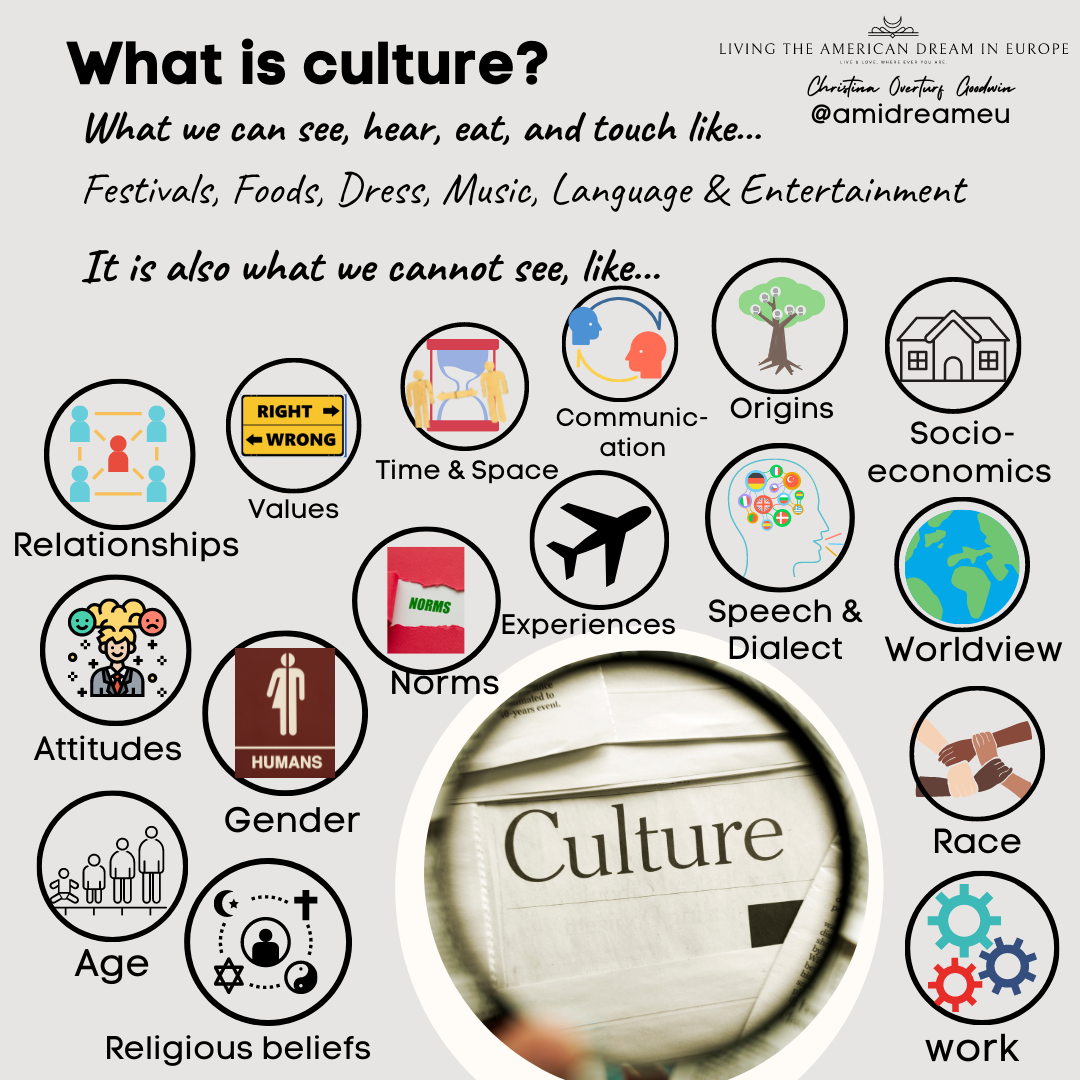
Here, I would like to mainly remind folks just how complex culture is compared to what we usually think it is. That is, what we can see, hear, taste, and smell versus that which flows under the surface but is really the engine driving each and every one of our interactions. 

Photo by Andrea Piacquadio on Pexels.com

The Ultimate Personality Test?

My partner likes taking personality tests, or at least he did in the past. Me, I can see their use in some settings but, partly because there is such a plethora of them available – I feel sometimes like it is all a bit far-fetched for me personally. That is not to say that they don’t work necessarily – just that they never worked for ME.

It wasn’t until I began traveling, living, and working internationally and then examining personally why I just don’t seem to understand some people (and vice versa, other people just not understanding me) did I begin to uncover and understand intercultural communication as the ultimate ‘personality test’.

All of this is to say, in our increasingly globalized world, intercultural communication can offer you insight into behavior patterns across the board that will improve your ability to understand and communicate effectively with other people.

Be Kind

Additionally, you never know what pressures are affecting a person’s day; in addition to external factors, there could be internal cultural factors at play. So, be kind to those you encounter. 

Over to you

Let me know in the comments:
How do you define culture?
What aspects (listed in the image, or not) make up the most important aspects of culture for you?

Word of the year?

I recently participated in a word of the year reflective webinar with Anna C. Seidel an expat coach from @global_mobility_trainer (Instagram) that was really quite insightful.

I wasn’t sure what to expect, but I saw that someone else I follow on Instagram, Vanessa Paisley, an English trainer and intercultural coach at Paisley Communication was joining in for the second year in a row so I thought I’d give it a go too.

Anna walked all of us participating through a step-by-step reflective practice to help us determine our word.

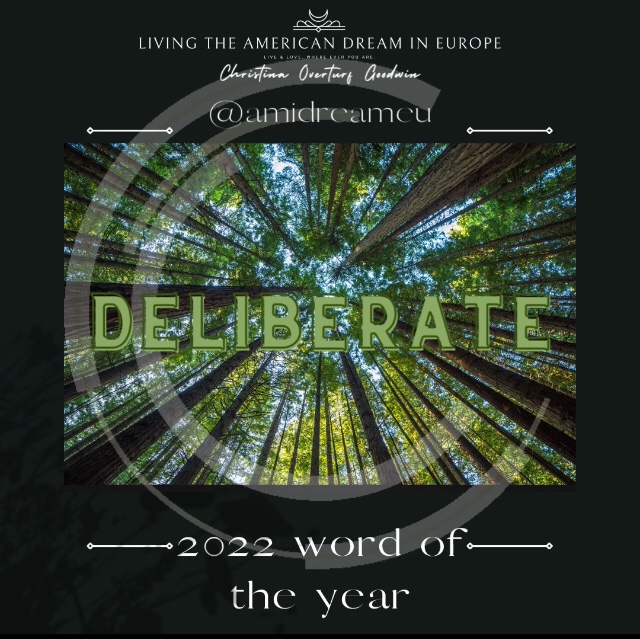
I had no idea at the start what my word would be. After about 25 minutes, I thought I had it. However, by the end of the hour, I had chosen a completely different word: deliberate.

Deliberate is an adjective that means to do something consciously and intentionally or carefully and unhurried.

Common synonyms include intentional, careful, cautiously, measured, and purposefully.

I realized during this guided training that all the internal and external work that I’ve been doing, especially during the pandemic, has been leading me toward being more deliberate with my time, energy, attention, and intentions.

Life during the pandemic has been one push-pull for me in general. I’m thankful for the ability to work from home, but because I use a screen for work, staring at it for hours on end has really deteriorated my ability to pay attention. I am thankful for more free time in some areas of my life but have been far too often upset with myself for not using that time better, say with my family.

What is the point here?

What even is the point of an exercise like this? According to people who do this exercise annually, it should help bring increased clarity and focus to who we want to become as well as what we want to accomplish.

A few years back I read “Drop the Ball” by Tiffany Dufu (I highly recommend it by the way) and one of her personal and professional goals is to help advance women and girls. As she explains in her book, she looks at all of her professional decisions in that light, “Does this allow me to help advance women and girls?” She will flat out say no if the activity does not. On a smaller scale, this is the exact action your word of the year should help you with, advancing your goals, whether they are short or long term.

Looking forward…

What areas of my life do I hope this word impacts? That’s a good question that I am not wholly prepared to answer other than to say, all of it.

Having decreased attention means I haven’t been as astute as I think I am in non-pandemic times. There are fewer distinct blocks of time devoted to work, commuting, family, etc., which has really cut into my decompression/ mental preparation time between these blocks.

In December 2022, I hope to look back and celebrate having been more deliberate in my actions and behavior. At the moment this means having more meaningful conversations and time in general spent with friends (and maybe family, if we’re able to see them in person again sooner than later). Professionally, this equates to developing my business craft with intention. In 2021, my goal was to figure out a more definite direction after achieving goals I had long put on the back burner. In 2022, I hope to develop that direction with greater intention and focus.

Additionally, this also means to cut the mindless scrolling or swiping down, way down. In the last few months, this has only increased. I am not happy when Apple sends me my personalized ‘weekly report’ to tell me how much screen time I have abused across my devices. When I stop to think and compare how I felt in January 2021 and how I feel now, it is markedly different. Last year at this time I felt so alive and energized with direction, even if I really didn’t know where I was ultimately going. This year, I feel rather overwhelmed at the sheer tasks at hand presently in front of me. I hope this will subside in the coming weeks, however. The nature of my work is tidal, it is nothing new. I have not yet hit on what in my life is creating this feeling. Year three of the pandemic, maybe – but I doubt that is it entirely.

Choosing your own word of the year

To help you choose your own word, you could follow these five steps:

  1. Reflect… (on the previous year and the year ahead)
    – What did you do that you want to do less of?
    – What would you like to do more of that brings you happiness or joy?
    – What is something new you want to try?
    – What characteristics would you like to inhabit?
    – Which characterists would you like to change?
    – How do you want to feel?
  2. Visualize
    Try to visualize your perfect day. The whole day, from moring routine to the time you are getting into bed to sleep. Focus on the feeling first, then what is happening in it. Are you at work or somewhere else?
  3. Create a list
    Spend about ten minutes just writing down words that come into your mind. Do not edit them.
  4. Review
    Look at the list you’ve created. What two or three words stand out to you and why? Circle those words. Throughout the rest of your day, play with those words in your mind. Which one is your favorite? Go with your gut.
  5. Ask yourself one final question…
    After thinking about your potential words, which one could you really commit too? For example, if your word was fulfillment would you want to commit to asking yourself in the future: “Does this activity or action bring me fulfillment?”
    – Yes, this is a loaded question that sometimes you are likely to answer no too, but that is the point. Unloading the dryer might not lead to fulfillment, but seeing your child in their sport uniform dominating during their competition probably does and having the correct, clean uniform is a part of that. On the other hand, if doing the laundry takes you away from your goals, perhaps you should see if it is possible for you to outsource it to another family member (for free) or to an establishment (for a fee).

    Now, if this is something you are interested in and would like to actually work with a coach to help you determine your word, you could contact Anna at Global Mobility Trainer.

What about you?

Have you chosen a ‘word of the year’ to help guide your year before? What do you think of it? Do you find it helpful?

If you’ve never chosen a word of the year, why not? Would you be willing to try it? Let me know in the comments below.

Do you like what I do? Why don’t you share it?

Find me on Instagram, where I usually post pictures and videos daily.

Happy Holidays from Germany

It is Christmas Day here in Germany.

I should be lounging on the couch, instead, I am sitting at my computer.

My trusted and lovely desktop computer died in August. I think it was all the video conferencing and distance teaching I was doing. It was rather old and just not used to it.

Luckily it let me finish out my semester and an intense summer language course before calling it quits on me.

This means I have been using my backup computer, which isn’t all that powerful or originally intended to be my main computer as my main computer. It is aging quicker than me these days I am afraid.

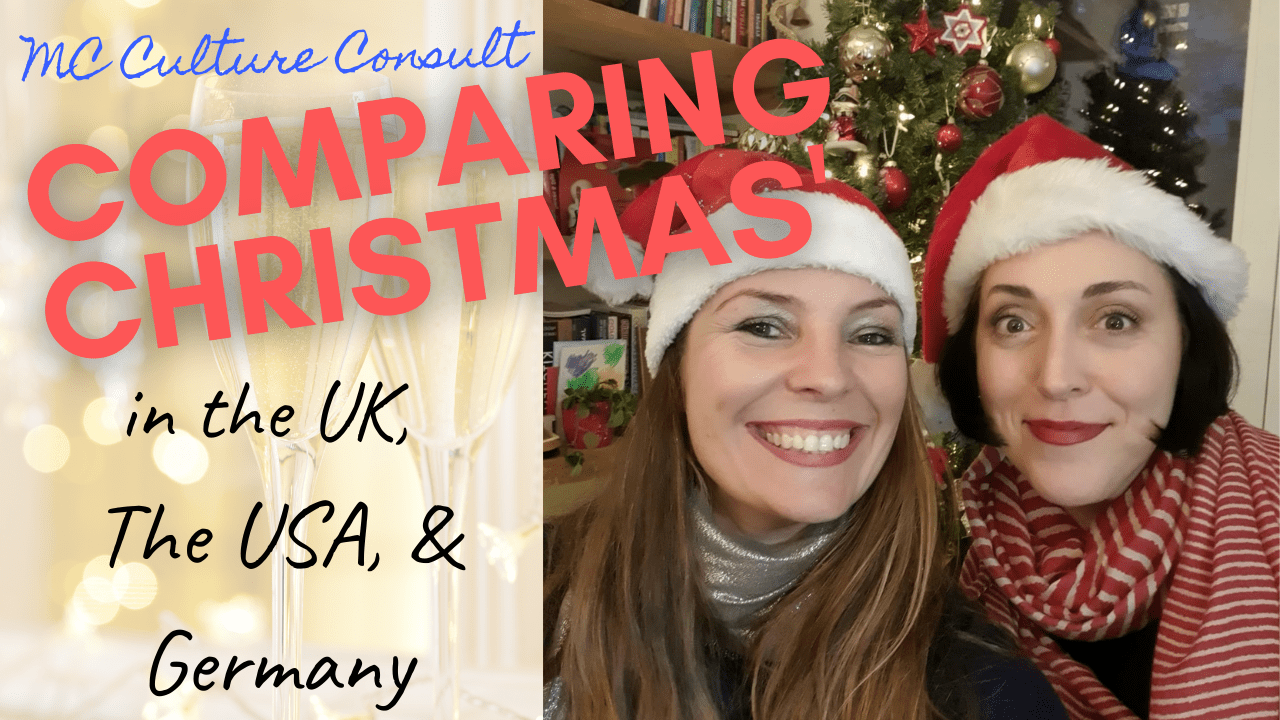
I mention this because my friend Michelle and I created a video as MC Culture Consult explaining the differences between our Christmas’ from the UK & USA compared to our German experience (and what we have learned about the German’s since living here).

Truthfully, it should have taken me a day to edit it, but five days later it is finally done. My poor computer…

But, it is done and I really am just using this as an excuse to do two things.


First, to wish you a Merry Christmas & a Happy Holidays if you don’t celebrate Christmas.
Secondly, to share the new video with you.

Click on the video for the full view. It is my holiday wish to you.

If you like what you see, you can find more about MC CUlture Consult over on Instagram, where we post regularly…

And you can watch other videos I have created, as part of MC Culture Consult & myself over on YouTube…

This is a very special episode of MC CUlture Consults’ cultural conversation on the couch.

I hope you have a nice rest of your holiday season.

Be safe, healthy, and hug the ones you care about.

See you in 2022.

A love of simple things

Did you know I have an instagram page?

I do. It’s @amidreameu.

I had created USdreamEU but then I lost access to the account. I don’t remember why.

At any rate, I post about all things related to coffee and culture.

Did you know that just about everything can relate to those two things, especially the latter?

It’s true. We often don’t realize our own culture‘s impact on us until we’re out of that environment, much like a fish out of water.

Culture is also a fishbowl.

Hence the saying.

I used to go to the gym. That was fantastic. I was in great shape and I was also sleeping incredibly well in spite of my ‘odd’ hours.

Sometimes I cannot sleep. so, I create content for my Instagram page. Creating visuals is easy, it’s the copy for the visuals that often requires more forethought than I’m capable of offering between the hours of one to five am.

Weights are a great stress reliever.

However, this pandemic is sticking around…so going to the gym is currently a little complicated.

You’d think maybe since I love coffee so much, that would explain why my sleep has been so disrupted. Maybe.

It’s so delicious…

That said, I usually have one regular coffee a day. Normally I stick to the decaf (blasphemous, I know, but true).

So, here we are. I don’t think that is the culprit. I did try to make an appointment with my doctor yesterday but he was off sick. I’ll try again later today.

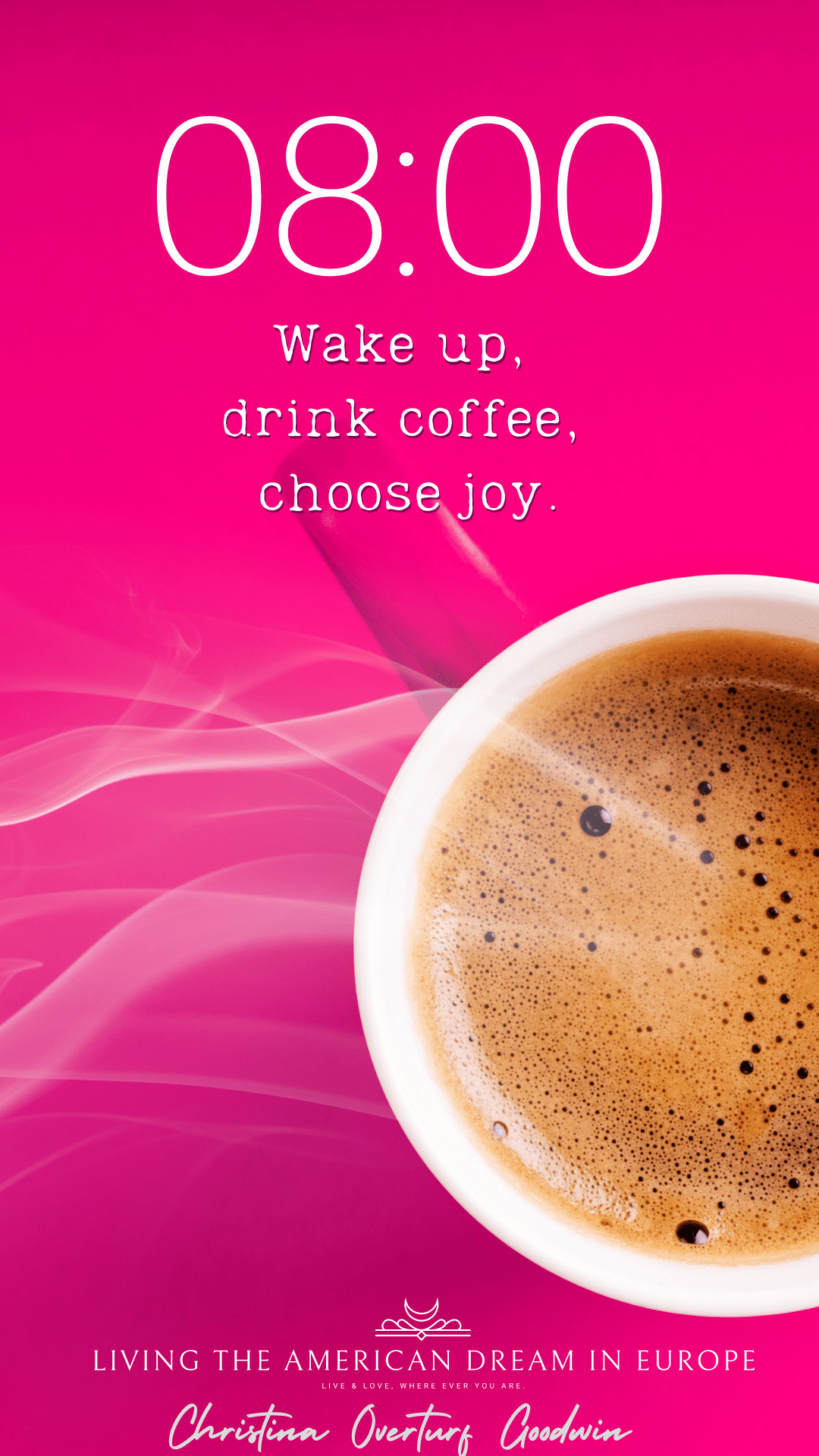
I’d like to present some recent designs I created, honoring my love for coffee.

Enjoy & share but please attribute to me.

Thank you.

Which image above do you like best?

A six word story about ME

[°This is prompt 6 in the #virtualcampfire2021 November writing series hosted by @chameleon_coaching & @southboundstories.

Image created by ME @livingtheamericandreamineurope

“I’m a verbose, life-improvement in process.”

Me

If you have seen my other posts you know by now that I have a lot to say. We all know that it is your choice to read any or all of it if you want.

For those of you that do read it all, I appreciate you deeply.

For those of you who don’t read all the way to the end, I get it. TL;DR! It’s okay.

When I put something out in the world, I attempt to be as honest & respectful as I possibly can be, to myself, to those involved with the content, and to you, my audience. Sometimes I may miss the mark, unintentionally. When I mess up, I will always try to fess up. I am an evolving work in progress, what else can I do?

As I said in prompt One “This is me”. You are under no obligation to take it as it is. Know though that I change for me, to hopefully impact the greater good. Not to fit your ideas of what I should be.

Oh, & I am here to support others, especially women but not exclusively, to be the best they can be, whatever that means for them.

What other possible ideas did I have when thinking of ‘My Six-Word Story’?

“One year I said, but then…”

“Woman, man, cat, & a lil’ boy“

“Curious, spirited-woman figuring it out internationally.”

“Creative, curious, interested in culture: Christina”

Over to You

Which is your favorite? Could you think of a better one for me? What would your 6-word story be? Tell me in the comments.

Lessons learned living outside my home country

This is prompt 7 in the #virtualcampfire2021#november#writing series hosted by @chameleon_coaching & @southboundstories.

Photo by Gelatin on Pexels.com

Traveling has taught me a considerable lot, each time I thought I evolved a bit more. Moving abroad long-term has made a considerable impact though.

I arrived knowing who I was & what I was doing.

Only to have that upended by my inability to speak the language.

Our German resources have expanded & grown over the years. Photo by ME @livingtheamericandreamineurope

Then, I found my footing only to become pregnant & give birth. Where was that old me? Was this takeover of body, of duty & obligation to this new living being all that I am now? What?! How could I simultaneously feel like myself but not?!

These were not only new international roads to navigate. ‘How to live abroad’ became ‘how to raise a child abroad’. Always feeling out of the loop or late to the party.

Photo by freestocks.org on Pexels.com

The number of times I heard “it’s not my job to tell you, you should know.” was numbing. “But if I don’t know & you won’t/don’t tell me, then who should?! 👀

Then, I found a community of international women & mothers in a similar boat. This helped me feel much more ‘Alice’, less Mad Hatter.

Enter global pandemic. Once again I felt late to the party & out of the loop, only ever playing catch-up. So, I decided to attempt to control my reaction to the world instead of feeling lost, while still moving forward-ish.

Change is the constant. Growth must be the equal. I may not always be in the calm waters, but I can be my own lighthouse in the storm. It means doing the personal/intercultural work to not get tossed by the waves of change or the constant evolving weather event that is navigating life outside one’s home culture.

This doesn’t mean going it alone, independently. Rather, it means finding those who speak to your heart, if not your vision, who feels like home, who support your progress as much as you support theirs.

Photo by Anna Shvets on Pexels.com

Tell me in the comments:
What do you think you’ve learned the most from recently?

An attempted rounded view of American Thanksgiving

On the fourth Thursday of every year, most Americans have a day (or a half-day) off work to feast with family & friends to show gratitude.

However, I am not only an American expat living abroad so I cannot just share the public-school textbook version of the history of this day in America. I was a student of history before I trained to become a teacher, specifically American history. So, I thought a more rounded view of this national holiday was warranted.

Here we go!

This is similar to Canadian Thanksgiving & German Entdankefest, essentially a harvest festival, the highlight of which is a meal consisting of turkey or Ham & fall vegetables. Charity also plays a part as well, usually giving to those less fortunate leading up to Christmas.

Our mainstream American history books all claim that in 1621 colonists at Plymouth & Wampanoag shared their fall harvests, but there was no stuffed Turkey. Prior to this, colonists had struggled to successfully grow food in their new world. It took cooperation and education on behalf of the Native Americans to help the colonists learn to be successful. In reality, it was only the second colony established at that time. Others had literally failed because the colonists to the new world did not know how to successfully grow their crops in the new soil – if the seeds even made it across the ocean. Native stories proclaim this was not a sharing, but rather a contact made for investigative purposes, like a fact-finding mission, as the colonists were ‘aggressive’ toward the local Native Americans. 

Previous interactions with the Native Americans resulted in waring & death/murder, the Europeans fought for constant additional space while the Native Americans fought to maintain their established lives. In fact, many Native Americans today do not acknowledge this holiday b/c of the historical devastation brought to their people from colonial settlement, European expansion, & Manifest Destiny. There were hundreds if not millions of Native Americans thriving in North America long before there were explorers or settlers, or even before America was ‘discovered.

This colony is important to American history & folklore as it not only establishes American Thanksgiving, it also establishes a puritanical ethic of work & modesty. It also predicates the NE region as ‘authentically American’ in modern American culture, since it was colonized ‘first’. It is also the foundation for ‘a city on a hill’.

Equally important, it is a Day of Mourning for Native people. There were hundreds if not millions of Native Americans thriving in North America long before there were explorers or settlers, or even before America was ‘discovered. Today there are only 6.6 million (2020) native persons in the USA, or 2% of the total population. It is difficult to say how many native people were living in what is now the United States and Canada as these records were not kept, however, there are general records accounting for how many likely died or were murdered, beginning in 1492.

It wasn’t until the Civil War when President Lincoln’s cabinet (in 1863) felt the American nation needed something to unite it. Yet, it wasn’t federally observed until 1870, on the last Thursday in November. It became a federally paid national holiday in 1875. Finally, President Roosevelt (FDR), in 1942, changed the date to the fourth Thursday in November, not a specific date, annually. It is also often a four-day weekend. The Friday following this Thursday is the start of The Christmas shopping season, also known as ‘Black Friday’.

Simple Actions You Can Take Today

Find Native Americans and indigenous folks to follow & support on social media.

Ask me for book recommendations to learn more about what I talk about in this post. 

(in)Tolerance?

This is prompt 5 in the #virtualcampfire2021 November writing series hosted by @chameleon_coaching & @southboundstories.

Living abroad has shown me how to live within myself more than ever before.

Whatever our education and experience level, we think we understand how the world works, common sense, and how to interact with others. The reality is, though, that generally we only know how to interact with others within our cultural group.

Blessed be those TKCs (Third Culture Kids) who grow up an insider to multiple cultures while also possibly not fully feeling like a part of any. They and a lucky other few have the opportunity to see and learn from multiple#diverse personal and cultural perspectives. Most of us have to learn about this along the way, on top of it in addition to our home, community, & familial culture.

It is true that traveling changes you in initially#invisible ways. We grow from the inside out, because much like the Tardis, we are bigger on the inside.

Like a fish in water who is asked about said water to only reply ”Huh, what is water?!” I could very easily see other cultures, but not necessarily mine.

Photo by MART PRODUCTION on Pexels.com

It has taken stepping away to adequately begin to process where I came from, both in the micro and macro sense.

Once I finally began to explore that, I knew I wanted to go deeper. I wanted to formally train to become an intercultural trainer. For years though, that goal sat on a metaphorical shelf in the back of my mind.

Then, we suffered a global pandemic. I realized after about a year that I didn’t want life to ‘return to normal’, whatever that meant, without having done something personally different finally.

Thankfully, I was in a position to be able to take action.

Six months of intercultural train-the-trainer courses with a ❤️ of reading diverse perspectives (& living abroad) has helped me to become more patient, more reflective, tolerant, & understanding of differing perspectives.

Next, I present a part of my bookshelf books that I love that has taken me to other places without me physically going anywhere.

It is with these books & a few others (especially Trevor Noah’s book, “Born a Crime” & Ibram X. kendi’s “How to be Anti-racist”) where I have become immersed in other worlds, rising with their characters’ victories & falling alongside their pain & tragedy, learning what their life is/was like. Something I would not otherwise inherently know because of my time & place of birth, not to mention who I was birthed to. They’ve given me a deeper understanding of the complexity of human experience. They’ve helped me also learn that multiple perceptions exist. That another’s autonomy may manifest differently than mine, but that does not devalue or differently rate it.

Honestly, if a student asked me to explain the word off the cuff in an English lesson, I would say “to tolerate, put up with, deal with”… similar to the German definition of „Tolerenz“, which another Instagramer explained is not necessarily positive.

That cannot be the goal of human interaction. To grit our teeth and ‘deal with’ people we don’t know or don’t see eye to eye with or shun & demonize because they don’t look, act, or speak like us – until we can return to our own little safe bubbles. Really?!

No. The goal must be greater understanding. If we can understand each other, not just in language, but in internal & external motivation, we may have an easier time meeting in the middle. It doesn’t mean we need to convince each other that ‘my’ way or ‘your’ way is better. Instead, this understanding should help build empathy toward others instead of against the idea we have of them.

It is through these (and other) books that I have learned that my heart can grow bigger, making space not only for people I have met but also for people I have yet to meet, whose stories I have yet to learn.

Over to You

Tell me in the comments:
Which books would you say you’ve learned the most from?

Food I miss living far from home

This is prompt #4 of the Instagram (@AmidreamEU) writing prompt #virtualcampfire2021, ignited by  Christina Kapaun @southboundstories  and Annyka Overton @chameleoncoaching as a series of writing prompts for ex-pats to share over the course of November.

My mother’s cookies – Photo by ME @livingtheamericandreamineurope

In short, I miss my mother’s cookies (and my mother).

Her cookies are perfection, plain and simple.

These cookies are legendary. Back in the day, she would sell them two for an American dollar to help fund her charity bike rides, and she constantly sold out. People were addicted, they couldn’t get enough.

Her secret? She says she just follows the recipe in the Fanny Farmer Cookbook. (I do too, but mine is never as good as hers.)

The last time I went home I asked her for a ziplock bag full of peanut butter and chocolate chip cookies to take back with me. At first, she refused because they’d turn to crumbs before I would even get on the plane. (If they lasted that long.) I told her I absolutely didn’t care.

So, she filled up a bag for me.
En route my husband tried to eat a few so I put a stop to that real quick!

I ate them all – even all the crumbs!

I could probably go on, but that is the pinnacle.

My favorite photo of my mother (with cookie and coffee [the apple does not fall far from the tree]). Photo by ME @livingtheamericandreamineurope
My mother & me. Photo by ME @livingtheamericandreamineurope


Explanation of the last image: The trip home where my mother probably gave me the bag of cookies-turned-delicious-crumbs. I had made a series of funny, yet horribly unattractive faces – this was the best one of the lot at the time.

Over to You

Let me know in the comments:

What is your favorite food?

Why is that your favorite and when was the last time you had it?